


ピラティスと3Dデータでスイングを変革:ミシェル・ウィー・ウェスト、スティーブ・ハンロン、ナタリア・プラパート
on tighter on. Hi everybody. Welcome to today’s webinar. Uh we’ve got a full house today and with some very very special guests and speakers. Um, and this is a a brand new way to use Sportsbox. And it’s really really exciting to have um the guests that the speakers that we have today because um you know I think we’ll all learn uh a a new thing or two about um how valuable the data can be not just for your golf swing but also for your your fitness as well. Um so I’ll go around the room and quickly introduce everybody here. Um, from Sportsbox’s side, my name is Ji Lee, founder C of Sportsbox. Uh, we have Dr. Phil Chetm with us. Uh, he’s our chief science officer. Edwin Fu, he is our head of sales. And, uh, CJ, who you don’t see on here yet, but he is he is lurking um, live uh, at the the Summit Club. CJ is our sales representative on the West Coast. Um, our speakers, uh, Steve Hanland, director of instruction at the Summit Club, Natalyia Plappert, um, she is the Pilates instructor and movement specialist at the Summit Club. They work together closely, uh, and they have worked together to create a really truly unique program, a new new program, um, for Discovery Land Properties. And then Michelle Wi West. Uh she obviously doesn’t need a whole lot of introduction, but um she is um five-time LPJ winner, major champion. So we’re really really excited to have this group of guests with us today. Um but what let’s start with some questions. Michelle, tell me a little bit about your game these days. Um I haven’t been really playing, but obviously I love the game. I still play in a lot of proams and you know outings and um you know always you know I think once you’re a golfer you’re always a golfer and you’re always um trying to get better um trying to be more efficient. Um you know obviously I have a lot of injuries as well so learning to swing more efficiently and um you know strongly is always something I’m looking forward to do. Um so my son just turned one so I’m playing a little bit more now but um not too much in the past year. Yeah. And uh tell me about this this journey. You’re obviously a member at the Summit Club and um yeah and and tell me why you’re excited about this. I mean obviously I um am invested into Sports Box. I am a huge believer in what Oh um I’m just I’m you know a huge believer in um you know and what sports box can accomplish. I mean you I if you know you know my history um I started playing really young and I just was beating balls for hours and hours on end. Um you know and when I was younger 3D data was not readily available. It was really only available to the top echelon. I was you know lucky enough to be in that top percentage you know kind of moving forward. Um but I could have practiced so much more efficiently. So I I just am deeply aware of what sports boss can accomplish for you know not only junior golfers but for the top level players as well too. Um you know just having the numbers be available to to really understand what you are doing with your swing and um you know it can also you know kind of like what we’re we’re doing now it will blaringly show what weaknesses you have in the body. So, I think it’s really interesting to kind of marry the two um and figure out what you need to do to do better. Okay. So, Steve and Natalia, um so you guys have tell us the genesis of how how this idea came together and then I I do want to talk about Michelle’s swing specifically and what you guys have discovered in her swing that um can be addressed with Pilates. Absolutely. Thank you guys for having us first and foremost. This is a uh this is beyond a treat and an honor. And Michelle, thank you for the time that we were able to spend in here doing uh what we did and getting you a little more efficient. So, uh I’ll let Natalya kind of explain where this all came from and how it’s evolved and where we’re headed. Yeah. Um so, I’ve been a Pilates instructor for a while and I was at the Summit Club and I kept seeing this guy walk past my studio with a golf bag on his shoulder and I remember asking, “Who is that?” Someone said, “Oh, that’s that’s our golf dire the a director of instruction.” And so I approached him and I said, “Hi, do you want to build a golf and pilates program with me?” And um after he got his over his initial fear of this woman sticking her hand in his face, he said, “Yes, I do. Absolutely I do.” And so we just started there. We started talking about some of the shared clients we had. And one of the most important things about Pilates is it builds neuromuscular control. And so what we’re really after is not to replace a training program or your golf instruction, but it’s really about how do I help you prevent injury, move more efficiently, and get the most out of your swing, whether you’re an everyday golfer and on the weekend or you’re an elite performer. Uh we would love to touch base with all of those. And so the idea just started to gather speed and and snowball. And yeah, and I think what’s I think what’s really interesting is this has been over a year to get to where we are and to where we’re comfortable. And most recently with the addition of Sportsbox AI in the studio here at Summit, um it’s a huge opportunity because we also have the luxury of Trackman, right? So Trackman uh working with the club and the golf ball data is amazing. But now when we’re pairing this with the 3D and AI technology that Sportsbox is bringing to us, um, I’m capturing body, I’m capturing club, I’m capturing ball, every single golf swing, we can just compile that data. And the luxury that those of you that haven’t used Sportsbox yet and should be. Um, no, is that everything is measurable and so it’s tangible. We can put our hands on it. And to Michelle’s point, I think it narrows the scope of practice to where we can save your body. we can make you more efficient and we can get you better faster. Right. Well, and and to the point, uh I benefit from Sportsbox just because it it identifies right where I want to be. What’s the precise movement that I’m looking for? And so then we get to sit in here and talk about all of our amazing players and go, what did you see and what did you see? And okay, this is what I’m going to do in my next session. And so every minute that you spend with either one of us becomes that much more valuable to the end result. Awesome. So, let’s talk about So, I’m going to start with you, Michelle. Um, you’ve seen your swing on Sportsbox. What were some of the things that you were curious about um working with this program, Natalia and Steve? Move a little bit so I can kind of see. Yeah, we can. Yeah, I mean, I think with my swing, I mean, obviously there’s, you know, many different versions of my swing. Which one did I get, Michelle? Which one did I get? I don’t know. You’re feeling this type of player right now. No, but honestly, um, you know, I had to change my thing a lot in my career with my injuries and whatnot. So, now that I’m two years out, it’s kind of almost like a clean slate. Um, you know, my my I’m feeling a lot better. I’m feeling a lot healthier. Um, so it’s actually really interesting to see the data right now because I think when you’re so deep into playing and so resultsbased um, you know, it it your swing changes um, you know, so much accordingly to your body. Right now I feel like it’s a clean slate. Um, it was really interesting. I think um, in back in June I was first on sports box like really getting my numbers and then the next day Ji and I were on the range for I think it was maybe 15 20 minutes. This is how short it is. It’s not even like an hour long session. Even the other day, I don’t think Steve, you and I were in there for more than 30 minutes as well. Um, but we were quickly able to identify one thing in my swing that created so there’s a bunch of different numbers, right? Like it’s so easy. You can get overwhelmed. But that’s why it’s really important to work with the coach that knows the numbers and like you just you get you take all the way all the numbers and we were just really focusing on one. For me, I found out that my hips sway to the right um when it increases, when I’m out of the range, I don’t create that X factor at the top and I end up um creating a slight reverse pivot unknowingly because my hip sway moves to the right. So, all I’ve been focused on since June, right? I mean, I don’t play every single day, but every time I do play, it’s so easy because I know the one swing thought that I have is to try and minimize my hip sway back. and my just by me doing that my torque my X factor at the top increases. Um so it’s just so easy. It was 15 minutes. It was you know and we were doing the practice mode where I would hit one shot and I I would I would either be green or red and then we ended up you know getting to the point where I would try to call out my number. So just really marrying what you are feeling to what you are actually doing. Um, and my tendency when I used to play was, you know, when you make a swing trade, just I used to overcompensate because, right, because that was the only way that I could feel it is that you kind of have to overcompensate to kind of get it back to normal. But this one was like it was so much more efficient because I was making the motion, but I was making sure that I wasn’t doing too much. Um, so we first were focused on hips sway and then we kind of tightened it up a little bit. Um, you know, I was telling Natalia, my my my uh pelvic, not pelvic, my chest turn. Um, I have rotation, good rotation going to the right, so my back swing, but I don’t have really I don’t have much rotation going left, funny enough. Um, which is, you know, you think, oh, back swing rotation is so much more important, but the rotation left is also really important as well, because what we’re saying in the numbers, everything is really good, and I want to hit a fade shot. Um, and what we’re noticing because I want to hit fades, my chest turn, um, at transition was a little bit too closed. So, I wasn’t able to stabilize my hip and turn with my shoulders into my left side. Um, so that is something that Natalyia and I have been working on in Pilates, which is like really cool because it’s so specific. Um, that, you know, movement, we’re doing movement with purpose. Um, and it’s just, you know, it can you can easily be like, oh, I need to do 10 different things. But it all boils down usually to one number which I find super cool and interesting. So that’s kind of what we’re working on. Um but then the other thing that this is the first time I’ve been to this page of a sports box is the kinematic sequence. I you know my mind was blown when I saw that too because when we’re working on chest turn I was noticing because I don’t have much chest rotation going left. My arms were doing the work. So instead of kinematic sequence one two three four with your hips chest and arm. What’s the fourth one? head. I got to three. I was noticing that it was my hips were always going first. That’s fine. But my chest and my arms were rotating at the same time. So, I need to stabilize my left hip and, you know, learn to rotate better um and separate my um spinal rotation. Bill, that was well analyzed, Michelle. That’s that’s impressive. Good job. Thank you. But that would have taken me that would have taken me days of on the swing like on the range trying to figure that out like and you know back in the day doing you know getting on camera drawing a circle around your head you know like it would have t it would have taken us so much longer to figure that out then it it took literally 30 minutes like it it took five minutes of analyzing and figuring it out and then it took like you know 20 minutes of me trying to do it and then we got to a point where I really couldn’t do it because I don’t have the the my body wasn’t um prepped right for it, right? So, as much as you want to make swing changes, if you don’t have that, for me, if I don’t have a hip stability and I if I haven’t been working on my chest rotation, it’s just not going to happen. So, that’s where we know, okay, I’m I’m going to stop beating golf balls is I’m not going to achieve this by just, you know, banging into my body. I need to get on the reformer. I need to do A, B, and C to get my body to do the things I want to do. Right. 100%. Well, and before we even get into the numbers, we kind of want you guys to think about um we’re going to use a a vehicle analogy and metaphor here. We want you to think about the power in the drive in a swing. Uh and mind you, I am like just learning golf, so I’m great, but you’re just learning. Amazing. Uh but that’s your power. That’s your engine. So, that’s where all of that strength, that horsepower comes from. And and that’s the part that I manage, right? I manage the horsepower. Right. Right. Sports box is your kinematic sequence. So, it’s going to show you and break down degrees and pieces and sequence all of that together. But the last part that we added in that makes this program and this methodology so unique and effective and effective is um where I come in. And so the neuromuscular control that I’m working on is the steering and the braking. Because if you have that car rolling down the freeway at 90 miles an hour and your steering system doesn’t work, you’re asking for a crash. So, as we kind of go through this, we want to continue to invite you to bring that mindset back to each part that we present today. That’s fair. That’s a really really good analogy. I I totally get it now. Um uh can we look at some of Michelle’s data? Uh yeah. So, CJ Yeah, CJ, can you pull up the uh the screen share part where they can see more of the data, the bigger picture? I think Edwin there. Right. So, a little bit of what Michelle and I were working through, um, and she set the table for me, honestly, quite perfectly, was she had explained to me that when working with Ji how she was working on how her right hip would sway, the things that that would cause. And so, in conversation with her and trying to get to where I wanted to go, she explained to me, again, like she did in her opening, she wanted to hit a fade. She explained to me how she was working her right hip. And so in this very first swing, one of the some of the data that we have up on the board here, I think it’s also important to emphasize that from the instruction side in using sports box AI, our goal really isn’t to make every box green because Michelle, I’d like you to speak to this for one second because as we look at the data, we look at her chest turn at the top and her chest turn is in red, right? So, it made a little sense that maybe she’s restricting the right hip to try to stop the sway that she was getting and that maybe that’s shortening up her back swing turn, right? But Michelle, if you want to speak to that real fast, you explain that to me, right? What happens when you you can rotate your chest more, you can rotate your hips more, but what happens? Yeah, I just I just don’t like it. I mean, it’s personal preference, right? I mean that’s um you know I I think that’s most important also to look at the numbers as well too is that yes these you know you want to be in the green but these are averages and I think golf is such a personalized game that I think it’s really important to recognize um you know why you’re in the red right like is there something is there a reason that you’re in the red for and for me you know I don’t I don’t really love a bigger chest I mean a bigger hip turn at my back swing u for me it just I feel like I don’t have enough control. Um but yeah, I mean chest turn is something that I am working on and I think that’s where the Pilates will really help. Um I think the two years of not really playing I my spine um has definitely tightened. I’m not 16 and more with a um you’re not you’re not going to see that swing anymore. This is a swing of a 35-year-old 36 year old. Yeah, a mid30year-old. Fair enough. All right. Well, enough about uh age before we get to mine and I don’t want to do that. So, here we go. But, um you know, interestingly enough, in spite of Michelle’s chest turn being a little short or in the red, her X factor max is off the charts and it’s in the green and well within the range. So, do we necessarily have to chase every red number? And in my opinion, when we look at sports box and we look at the data that it gives us, no, I don’t think we do. Right. So, in talking about and in working with Michelle and what we can see here, the big one that we we started to notice and Michelle was complaining, I don’t want to miss the ball left. And so, really down swing, arm horizontal in that first position, we started to notice that Michelle was was still a little bit too closed to the target, right? And in doing that, um, if we can go to lift, CJ, right? And in doing that and going to the lift, what we started to notice uh is that her pelvis, for whatever reason, as she was starting to play or practice and hit balls, she would really drive down and the pelvis would drop really deep. And so what we discovered through having these conversations and hitting golf shots is that we both believed that the pelvis got so deep that she’s spending more time coming up than she has the ability to go ahead and rotate open. And so through that luxury and what we started to see is that the chest turn at impact where she was was in that 22 range, right? Um you have the turn. Yeah. Perfect. In that uh at at the impact was in 22 degrees. And then when we started to get Michelle firing and understanding that as we’re looking at that data and we’re not digging in with that pelvis, but we had the pelvis just moving a little more to her, the idea was level and to the left that we were able to get her chest four more degrees open at impact and out of that yellow and into the green and the corresponding ball flight started to show up. Right? So, without being able to see that and without her being able to see that in uh Can we do that in the 3D, CJ? Right. If we can put that in in the 3D and then probably show it from the overhead, I think would be really ideal if we can get it up there. Yeah. Right. So, when we take her down swing at halfway, the chest was still really overly closed. Right. The pelvis would start to really drive forward and down and dig in. And then really she didn’t have much of an opportunity. Wait, will you remove the the bar in the right, please? Thank you. Yeah. So, she didn’t have the opportunity to to get herself open so she could create the club path that she wanted to create, therefore taking the shape of the ball flight that she wanted to produce. Right. So, and then as Michelle alluded to as well, the kinematic sequence was a little bit off. we were firing the hips always go first. She does an amazing job at making the hips go first, but then the chest and the arm started to just kind of fall. They weren’t really rotational. And so we were in that one 1224 range. And then if we move to the better the better version, can do you have the better version up there, CJ? Oh, you’re split screen. Okay, great. You’re amazing. Look at you go. Okay, so in that better version, Michelle’s pelvis stayed a lot more level. Also, the pelvis drop went from -2.7 to – 1.3. As I said there, that chest rotation at impact moved from 22 to 26. So, we got her more open and she felt like she wasn’t working quite as hard to rotate because we started to see the pelvis stabilize. Right. Can we see those data points? I don’t see the lift data. I don’t see the turn number at impact up there. So, in the lift data, CJ And it shows some indicators for lift. Okay. Chester at impact, right? Or is it spread at impact? Mhm. Yep. It’s right under there. Yeah. You got it. Are you getting them? Do you see them? Can you see them from your side, Ji? I don’t. Okay. I wonder why that’s happening. I think he’s standing in front of him. Me? Yeah, they’re on the bottom left. They were on the bottom left. The screen share should show it. Yeah. See? Okay. The chest turn at impact now. Yep. There you go. So, chest turn. Yeah. So, we So, we saw it go from 22 and open itself up to 26. And then on top of that, right, like we said, the kinematic sequence right there went from that one, two, two, four back into one, two, three, four, Michelle. And did did that feel like it was very hard or or difficult? Right. It was just a pretty simple conversation about discussing the movement of the pelvis and how the pelvis would glide and not dig in. And then that seemed to help a lot. Totally. It just it it was so much more of an efficient swing. um you know being able to keep the the club head speed up um without having to have so much motion um it felt very clean. Superb. So that was our session. I mean, and to Michelle’s point, right, we spent what, 30 minutes doing what we did, and the key indicators, you know, that we’re looking at, I think, are all key indicators are really simple ones that you guys at home and everybody tuning in here, these are these are not massively difficult ones. I think they’re relatively simple to kind of see in 2D video if you don’t already have sports box. But that pelvis drop in the down swing and then the chest turn at the impact, I think are both pretty simple for you guys um as you get out working on your own game to create the proper rotation so that you can create the corresponding ball flight uh that you want to play. So now I’m curious um how did Pilates address some of these things that um what what kind of movements and exercises did you do to target these? Well, we’re going to move over to the Pilates studio here in just one second where we are they’re also live. So, I’m going to let I’m going to let them go over um and get you set up and get ready to go and then um does anybody have any questions for me as as our session as they move over and then we’ll switch out of here and move you to the studio because we want to show you the movement on the reformers um and what we can do in in lie of not having a reformer and how you can do that in some other ways too that are going to strengthen and get those finer uh as Natalyia said steering and braking capabilities put together. Um, so if anybody has questions and Ken, it looks like you have a question. Use the Q&A button at the bottom. Uh, along the bottom you should see a Q&A button. Try to stay out of that as much as I can. Okay. And uh, Michelle will be leaving us now. Thank you so much for joining and and giving us an insight into your swing and the sessions that you’ve had. Uh, we’ll see you soon. Thank you guys. Bye bye. Thank you Michelle. So any questions before we go over there? I think they’re in studio. So I I I think it would also be a really great opportunity for you guys to understand that in this little method that we’ve put together and and in in building what we’ve built, this would be a very typical session for a member. We’re going to get the member in. We’re going to do the sports fox AI assessment. We’re going to find the key indicators for this particular player. to Michelle’s point, right? It’s so individual, but we’re going to find the key indicators um for this particular player. Natalyia and I will sit down generally every afternoon once we’re both finished. And if we’re sharing students, this is the opportunities where we watch the we watch the movement patterns. We’re watching what the numbers and the data are telling us. And from there, this is where Natalya starts to get specialized and she can start to get the player moving into the right movement patterns and strengthening those areas that need to be strengthened. Steve, I have a question comment for you. You talked about the kinematic sequence since you went from 1 224 to one two three. I don’t know if you looked at the the speeds of the chest rotation and the pelvis rotation and arms in the kinematic sequence as well. I wonder if they went up a little faster or were you mainly concentrating on shot shape rather than club head speed? Yeah, club head speed I just I mean we have the luxury of Michelle Wi, right? So, I mean, you know, for I had a Ferrari in the studio, Doc. Um, so we weren’t really necessarily worried about the club head speed. More so that to your to your point that it was just happening more in the right order, but I would be I would love to go back. I didn’t spend any time in it because Michelle and I didn’t want to dig into any of that. So, I would love to know the answer and I’d be happy to get back to you and we can talk about that because I that would be a great conversation for me. Yeah, that’d be interesting to look at. Yeah, I will do that for sure. That’s a great one. Thank you. Anything else before we go over into the studio? Great. We’ll head over there and uh we’ll let Natalya start to take take it from here and she’s going to move us through some of these things on how we wanted to work with Michelle, get Michelle a little bit stronger, get her feeling a little bit better in those fine motor movements. And uh with that, I’ll say go ahead and take it away and thank you guys for being in the sports box AI studio at Summit Club. Are we in? Yep. Awesome. So, this is our belonging studio. Um I have Anukica here with me, a fellow instructor. So, I don’t expect your moves at home to look much like her. She’s been practicing for a long time, but she didn’t model for us some of the things that we talked about. So in that analogy we gave when we first started, we talked about that car with the horsepower um and the bigger muscle movements and using sports box AI and the 3D technology to capture that back swing and all the way through um and the kinematic sequence and chain. Now we’re going to talk about the precise steering and the brakes because that’s ultimately what’s going to let you play longer and enjoy the game a little bit more. So, we have three areas where Michelle will be wanting to improve. And one of those that we’re going to talk about first is her quad strength. So, Anuka is going to join us on our she’s going to sit on her box first. And she’s going to bring her left foot forward to the little platform here. And she’s going to place her heel high up on the box, gently bringing herself to stand. Her back is nice and long and straight. You can see here now when she bends down to her left knee, she’s going to think about keeping that knee right over her ankle, creating that 90° position. Her chin stays up, her gaze stays focused, and she’s using the length as she rises up with balance and stability. So, as she continues to move through this movement, we’re going to talk about what she should be feeling and where she should be feeling it. We really want her to feel control in that quad muscle, a connection down through the bottom of the heel and length. So flexibility, right? You can take that arm back or you can take that leg back. But what I want for you as players and athletes is to have control and to be able to own that movement. That’s mobility. I might even have her stop at the bottom. So she goes into her lunge, hinge her heart forward, and then she’s going to scoop that back leg in and out like she’s riding a scooter down the street. This is really going to turn that quad on and give her nice way in there. So this is one of the moves that we practice in the session when we’re talking about quads. As she rises to the top out of that lunge, she’s gently going to turn herself towards that side. Placing her right foot against the box and the left foot at the edge of her platform. She’s going to lower down into a little squat. This is hip stability as well as quad strength. And again, she scoots the carriage away and pulls back in. So, I’m looking at is this side, that standing stable side, pulling nice and strong, or are we seeing some of that pelvic sway that we just talked about when we were in the simulator? I’m looking for a long spine. I’m looking for smooth control. Bodies is about precise movement in every single thing that we do. Another one that we might do is she’s gonna hold right here and this time she’s gonna extend the left leg pushing the carriage away from the other side. If I have her alternate this movement, right leg long, bring it in, left leg long, bring it in. Now, she’s got to ask herself to have control on both sides. So, that weight shifting is another way that we kind of practice that holding control. She’ll bring it all the way in and then gently press herself to standing and step on down from that box carefully. We always make sure we step on something that’s solid. I’m going to remove this box right back up. Same feeling platform, only this time she’s going to turn her toes towards the outside. So, she’s got some external rotation happening here. Her arms come up overhead and as she presses the carriage away, she bends into that front knee, directing her gaze over her fingertip and rise. And again, I’m looking for control here. So, she’s using adductors in her thighs to pull that carriage back in. Control the stabilizing hip and strength through that quad. So, a lot of the exercises we do are not just training one single piece of her body. We want all of it to work together in this really efficient movement. This time she’s going to hold that warrior two for me, extending that right leg out and in. She never brings the carriage back so that the knee is over toe. She always keeps that 90° angle from that strength and length. Gently bringing it all the way back up. She can step her right foot back to the floor. Beautiful. The other part that Michelle was talking about that she needed strengthened was some hip stability. Right? So making sure that this is all gold in what she does. So this time I’m going to have and we’re going to do some unilateral work. And I love unilateral work. This is where I think about you guys. Stephen and I we love to decompress after a long day and talk about what our clients are doing. That’s that’s what brings us joy. Um, and so unilateral work is really a lot of fun because it’s going to point out for us where we have an opportunity on one side of the body or the other because we all develop these compensatory patterns that tend to affect what we’re doing. So, we’re going to take that foot into the strap. She’s going to put a little tension into that glute and pull the right knee in towards the chest. Now, her right leg doesn’t do a thing. She’s focused on that left side. extending the left leg long. She stabilizes through the pelvis by dropping her tailbone to the mat. And then that long straight leg comes up to 90. When she’s at 90, notice toe, ankle, knee, hip. It’s all in one long line. She is not controlled by the loop. She is in control of it. Got back down to 45 and then straight back up. This is surprisingly difficult to do, especially if we don’t have that control. If we’re tight, that tight hip tends to try to lead the way. So, this kind of work is fantastic. Once she’s back at 45, I’m going to have her bend that left leg into tabletop. Now, she flexes the foot, driving through the heel, right connection to the glute. We push straight back out. There’s so many different variations of this movement. As she moves, she might feel opposite and stretch the right leg long when the left leg comes in. And switch here. And the entire time I’m looking for a neutral spine. I’m looking for control. I’m looking to see, have I given her too much weight? Does she not have enough weight? Sort of reading the cues on her faces. And then for this last one here, she’s going to bend that left knee in. Let her right foot find that foot bar. Perfect. You’re so close. There it is. And then gently, take that foot out of the This time as Monica comes up, we’re going to talk about thoraxation. So, one of the most important pieces of golf, right? She’s going to step over to the same side that I’m at, and we’re going to sort of mimic her swing. So, she’ll take that block right in between the forearms to create space almost like she’s holding a club. And then I’m going to give her a long leasing her fingertips together, she softens her knees. So, we’re talking about that dissociation between the bottom half of her body and the upper half of her body. And then using her side body with that strength, gently she starts to turn towards the left and then resist it back. Now I’m gonna change her spring here because I want her to get a little bit more movement and learn how to control and bone that. So again, as she swings towards that left side and back. Beautiful. And a couple more here. Swing and back. Then I can take what she does in his lessons. what I see from sports golf sta in the simulator and apply it to her lesson. Now, Anna’s only doing one side for you guys, but anything you do to one side, you do to the other. We always train nice and evenly. The last exercise that is going to show us today, one of my very favorites. I’m going to take that block from her and she’s going to find herself kneeling on that. So her right foot is going to go nice and flat kind of like a captain sty. So rise on top of that foot. Yep. Now this requires a lot of stability. So I am always telling my clients to go slow. Feel the movement before you go wild and crazy. Last that loop in between both hands. She’s going to start at the center of her chest. And the same thing, she starts to twist, creating dissociation between the bottom half of her body and the top half of her body. So she’s using her opening strand here, creating that rotation, holding that strap nice and firm. I’m finding external rotational. You’ll notice again her knee is directly over her ankle. Right? You don’t have a reformer at home, but you have a thera band and a banister. You can easily tie that the bandana around your banister and start any of these movements today, wherever you’re at. Beautiful. And then she’s going to bring it on down. And so that’s how we’d like to make these sessions applicable to where you’re at in your game and what you’re doing. And then the data that we’ve collected and the instruction that Steve has given us and then we apply it to neuromuscular control. Awesome. Yeah, I could uh I know for those of us who are live, this is amazing, but I could just see how we can uh layer on like, you know, sports box data that you want to address to the movement that you just showed us there. Exactly. And like I said before, Sportsbox affords me the opportunity outside of their golf instruction to really highlight what my client needs for their body. And then every single minute that you spend with me is just that more much more valuable. Yeah. So, I’m curious from um you know, when a member comes to you, how do you how do you look at the data and how do you present the the prescription like what you want to do in the Pilates class? Is it um here are the numbers and then do you look at it, you know, prior to the Pilates class and do you tailor and like customize the program based on those things? I’m curious how that all works. Yeah. Well, I mean, we create a profile team again. If the person comes in, right? So, we would have Anus profile ready to go and then this guy gets to start the hardware first. He gets to go into the simulator and take the data. And you want to talk a little bit about how that process begins and how you start that. Yeah. So, in building the profile for the player, you’re really curious as to what are your plans here? Is this are you looking for me today and do you want me to repair the repair the dip so it doesn’t you know explode while you’re out on the golf course or are you looking for a long-term solution because if you’re looking for a long-term solution you found us. So the key for us really the first thing in when is building that profile is where are we headed? What are you interested in? And then we’ll capture all the data. Natalyia and I generally, like she said, this is this one of the things that we kind of nerd out on a little bit. We’ll sit down, we talk about our clients, we talk about our shared clients and what’s happening and how they’re living. We share, we will look at the data together. We find out where there are opportunities. We look at the 2D footage as well, right? Seeing how the player is moving, not in three dimension, but with actually in the 2D camera. So as we do that and as we start to then figure it out and the master Natalya sort of takes over and now Natalya is going to build that program and look at them and we’re going to have these conversations with the player which is then to say we’re noticing some issues in in how the left hip is is not rotating you’re trusting right so where is that coming from and and to answer your question directly yes every single session really is tailored to this specific client so it’s not just her program, it’s her session every single time. And once we have that diagnosis with your goals in mind, then we get to go about digging into that steering system and saying, “Okay, if it is in fact a turning problem, it’s not just a turning problem. You got to go deeper. There’s a layer underneath. Is it that we have a weak glute? Is it that we have an injury that we’re nursing? Do we have weak inner thighs? Do we have some other compensatory pattern taking over in a driving session? And what’s so cool about this work is that just when you think you found it, something else pops up and we go, okay, we’re back to the drawing board and now we take what got us here won’t get us there and we’re going to go back and do it again. And so that’s what keeps it exciting every single one of the people that we get to work with. I mean, one of my favorite stories that Natalia and I share this shared uh a number of clients here at the club, but this one fellow went through when to tuffle bypass surgery, which I didn’t know was possible. I only four bells with this guy special about five, right? So, um he came to us after the surgery and couldn’t balance, really couldn’t rotate, couldn’t stand on his knee leg. And so in a conversation with him in a golf lesson, which is right about where it started, I said, “Have you ever thought about Pilates? Have you ever talked to Natala in that gym? Have you ever done anything like that?” And he hadn’t. And so we made the introduction and he’s not what three times a week. And and I think I gave you the best golf lesson you ever had. He doesn’t want to tell you that, but knowing nothing about golf ball, I possibly gave him the best golf lesson that he ever had. But the success that this man has had, the speed at what can 756, the speed that he has picked up, his enjoyment of the game has gone through the roof, he’s moving better in life, right? And yeah, the way that she’s describing how the body works, she made a suggestion of yeah, how I spiral my lead arm and where it comes from and where I had to let go from in the lower lat. Um, and so yeah, it’s made an enormous difference not only in the members game, but I have never played better golf from some of these things that that have happened with the club. Look at that. It’s very cool. Dolly, are you seeing an increased male participation in your classes? Oh, it’s it’s so interesting because I think there’s such a stigma around Pilates that it’s just for girls that it’s a woman thing that we want to just get dressed in cute clothes and drink matcha and play on our performers all day long, which we we do want to do all of those things. It’s a little bit of that. Absolutely. We do. I love um but what’s so interesting is that as more of the and at the club and just in general want to enjoy their life and move a little bit better. And I talk about this all the time. If your hips are locked up, you can forget about that squat rack. You’re not adding any more weights to that thing. If your glutes are not firing the way they should be, there are certain moves out there in the gym that you’re not going. So, my job is to supplement what you are doing. And so, yeah, we’ve seen a lot more male participants. And it makes me so excited because it’s just so interesting the goal that we all have and the way that the body works differently, but ultimately the bottom line is I want to enjoy my life and for a longer time and and that’s what the program does. You know, we we don’t share this client, but this is a client of hers that she spends an inordinate amount of time with. Share the story about Oh my gosh. I had this client with him for two years and um he had a really hard time to balance the stability, really tight hips. And he gets back from a business trip and he says he calls me says everything okay I was on the plane. I had to go to the restroom. So I just stood up. I said, “What do you mean?” I just I just stood up. I didn’t push down on the armrest. I didn’t pull the seat in front of me. You got four person in front of me. I didn’t twist. I didn’t drive. Excuse me. I just I just stood up and I went and I thought everybody’s going to be responsible about because it’s it’s so magical when your work and your passion can affect someone to the point where the little things in their life are that much easier and that much more enjoyable. Yeah, forgot all that. And then as we start to build that into the player where the player is noticing incremental yardage gains, they’re noticing better balance, they’re noticing more stability in everything that they do. We’re watching people will come in and out. And what we’re what’s really happening here from a club level, if any of you club professionals are tuned in today and you have a fitness professional that is at our club, we are intershing a lot of the truth. And I’m getting ladies in my ladies golf clinic that have never golfed before because these girls are like so excited about what they’re doing in this room that they want to carry it forward and take it to the next space, right? And that space happens to be outside. happens to be the golf course. Connection to community. Connection to community. And that like that’s the reason you joined a club, right? I’m at a club for for a purpose. And so these all of these little things that are intertwining throughout what we’re doing and how sports talks have brought us uh that much higher than what we were doing before because now it’s tangible. Now it’s measurable. We have groups interacting with one another. We have people playing better golf. And in and out of this studio are are major owners of businesses. They’re owners of professional sports teams. They’re professional athletes. We have Michelle Lee and other major league baseball players coming in and out and getting on these reformers. So yes, J it really is happening. And I think you know one little brick at a time we’re breaking down women’s only mash. Yeah, we’ll let the boys in. It’s fine. Exactly. We were trying to keep it a little secret for a while. Now the secrets out. Share. I’m so sorry. I have to share. You guys keep all the good stuff. Yeah. I I saw Mich Michelle post with uh Johnny participating in a Pilates class that I thought I was like, is this is this real? Like is this really fun? Yes. It’s so much fun when people come together. I will take credit for building Johnny here. I love it. that you were going to be in studio tomorrow morning at 9. He begged and I told him no. Sounds like you guys have a a customer for life in this program. But um let’s let’s summarize for everyone. um give us top three swing flaws that’s measurable on sports box and you know what uh I guess movement needs to be strengthened or targeted in order for them to you know fix those things. Sure. I I think the very Yeah. I think the very first one and I see this constantly is is hip slide versus hip rotation. I think that’s that would probably be number one for me as I start to look at the key indicators. Uh that’s what Foxy is. It’s all over the place. You know, for whatever reason, it’s a pretty interesting thing. I think when we’re vertical, rotation is very simple. And the moment that I add hit and I move forward, rotation is very confusing and people don’t tend to understand it as well. So, hit slide versus hip turn would be first. So, this is going to be that skater that we showed you initially. So, she’s going to come down into that squat and I’m gonna have her alternate so that we can really get an idea of what Steve’s talking about. So, she extends her right leg long first and then she’s going to extend her left leg long. When he’s talking about hip slide, and I’m going to have to ask you to use bad form here for one second slide back so good at this. You can see how this kind of juts out to the side, right? And when she does her right leg, maybe she leans in or her knee starts to collapse. So don’t she’s so good at it, but she’s gonna go back to that stability and back to her movement the correct way. And you’ll notice she’s just working right within that frame. So it’s just the leg that’s doing it. And so that’s one of the major things that CC’s and this is one of the best exercises. If you don’t have a reformer, get a hand towel from the bathroom, go into your kitchen floor, and slide that towel in away from you. You don’t have to have a huge piece of equipment to participate in Pilates. What do you have next? I would say that really the kinematic chain is another one because for most of us, as I see on the up on the practice range from the top of wherever they start that the chest begins to rotate first. it goes out of sequence. It changes how the whole body delivers the golf club. And so I would say to you is that how we look at how the body is unwinding. So kinematic sequence for me is the big one because I can talk to a player. You know, part of my goal is to take the the vastness that is Sportsbox AI with all of the data and all of the numbers and be able to translate that to you, the player, so that you have the ability in your brain to put that in order if I kind of burden you down. I can know what all the stuff is. It doesn’t mean I’m I have to, you know, give it to you. So the kinematic sequence is a way that I can explain to them that here’s how the body is not in the wind. That would be a second one for me. Okay. So that’s two pieces in what I hear as fantastic. The kaotic sequencing ball really is when you talk about that unwind unwind. It really is about rotation. So this exercise here, the first one is we’re going to do that same classroom with the hands and start to contour towards the side. This is a little easier than that Captain Morgan that you were in, right? A little bit less balanced. She’s probably a little more comfortable on her box here. So, that’s the first way that I’m going to address. Let’s see. The second one is something we call draw the swords. She’s going to grab her long weight in her left hand because so much of this game in any sport, right, is mental. And you talked about can I get this into your mind about how to unwind, you know, one, two, three, four. I’m going to give her a little mental exercise. She’s going to flip the palm to face her body. She’s going to pull the elbow high, extend the arm out, bend the elbow in, and return that sword to a chief, so to speak. And so what you thinking one 2 3 4 that sort of mental exercise translates back and you saying okay let’s talk about hips chest arm club it um then they can kind of do that in both of those settings. So I’m going to give that to her in those two pieces. And then this is also strengthening her back, strengthening her arms and keeping her present with us. All right. And then as well as hip sway and kinematic sequence, I think chest play is also another one. Right. As I explained to you guys just a moment ago, in kinematic sequence, we tend to see the the chest either lean first or we tend to see the player pivot around the trail leg. And so where that chest way works and how chest way uh I think is easily explainable to the player so that they can understand that how we’re trying to move and where that body and chest is trying to in space. for moving around. I love that actually because all right, she’s going to move her arms around her chest and she’s going to place her hands into her loops here and we’re going to go small today. Yeah. So, neutral spine, meaning she has a little bit of a space on her back. She’s going to sink that tailbone down. Hip stability. She’s going to sink her ribs down. chest. And then she’s going to lift those legs into what we call tabletop. So, I’m looking for a couple things in tabletop. Are her heels above her knees where her food or whatever is on the table would slide or are her heels below where it would slide the other way? I want to be able to balance right here just right out of those shins. So, she’s going to tighten her core. And as she exhales out, the arms come straight down by her side. Strong wrists, straight fingers. When she inhales, the wrists come right back. And again, just like you saw her leg in that initial exercise that we showed you, fingertip, wrist, elbow, shoulder. And again, as you keep moving your she’s going to show you a couple progressions. So, as we work with people, they’re going to get stronger. It’s just a side effect of of our program. Sorry. That’s just what’s going to happen. So, we’re going to start to add. Next time she takes the arms down, she might add a chest lift and then lower back down. Next time she might add those legs long out towards 45°. Beautiful. This time she’s going to do an arm circle for you. So the arms will come down. She’ll open them up to a T and then go straight back up. So we’re talking about having that club move around. We’re talking about the arms moving around. And that chest stability matters. It’s not just rotation. You have to be able to hold strong whatever the elements are, whatever your move is. Awesome. Well, I can’t thank you guys enough for setting all this up and showing us uh the the demonstration of what looks like really really difficult movements. Yes, but um it’s cool to be able to relate, you know, the the data and the swing faults that that we commonly know to movements in this format. And I can say for uh myself as well, this year has been a journey for in improving like the stability and the neuromuscular connection to be able to actually swing better. So um thank you guys so much for today and um we’ll uh yeah, I I can’t I can’t wait to hear more about the success of the program. Yeah, thank you so much to our beautiful model who came in and showed you those moves and and yeah, I’m happy to have her. It’s such a treat. Yeah, thanks for thanks for having us uh for sure and uh look forward to getting with more of you later down the road. Awesome. Yeah, I really enjoyed looking at the progressions and watching how you progress from one movement to another. That looks like an awesome program. Thank you, Natalie, Natalia, and Steve. No, our pleasure. And that is it’s very we want you to progress. That’s our main goal. We want you to be able to do more and do it better. Awesome. All right. Have a great day, everybody. Thanks guys. Bye.
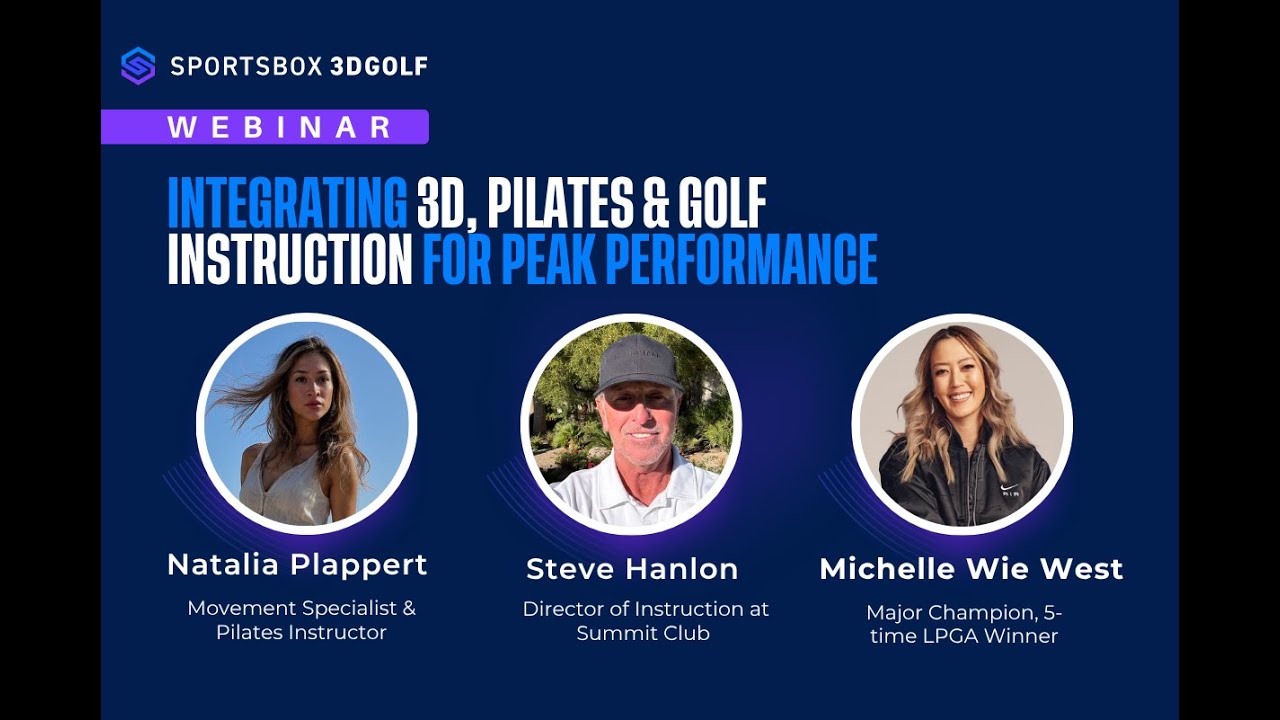
Unlock the secrets to a better golf swing with Michelle Wie West, Steve Hanlon, and Natalia Plappert at the stunning Summit Club—home to a first-of-its-kind Pilates-for-Golf performance program. In this session, we break down how targeted Pilates training improves mobility, stability, and power—three fundamentals every golfer needs.
Using Sportsbox 3D data, Michelle, Steve, and Natalia analyze key swing metrics to pinpoint exactly where the body needs more strength or mobility, and how specific Pilates movements can make immediate, measurable improvements. You’ll see the before-and-after, understand the “why” behind each exercise, and watch Michelle put it all into action.
Whether you’re a pro, a coach, or an everyday golfer looking to move, swing, and play better, this is a masterclass you won’t want to miss.
Fantastic well done 👏🏻👏🏻👏🏻