



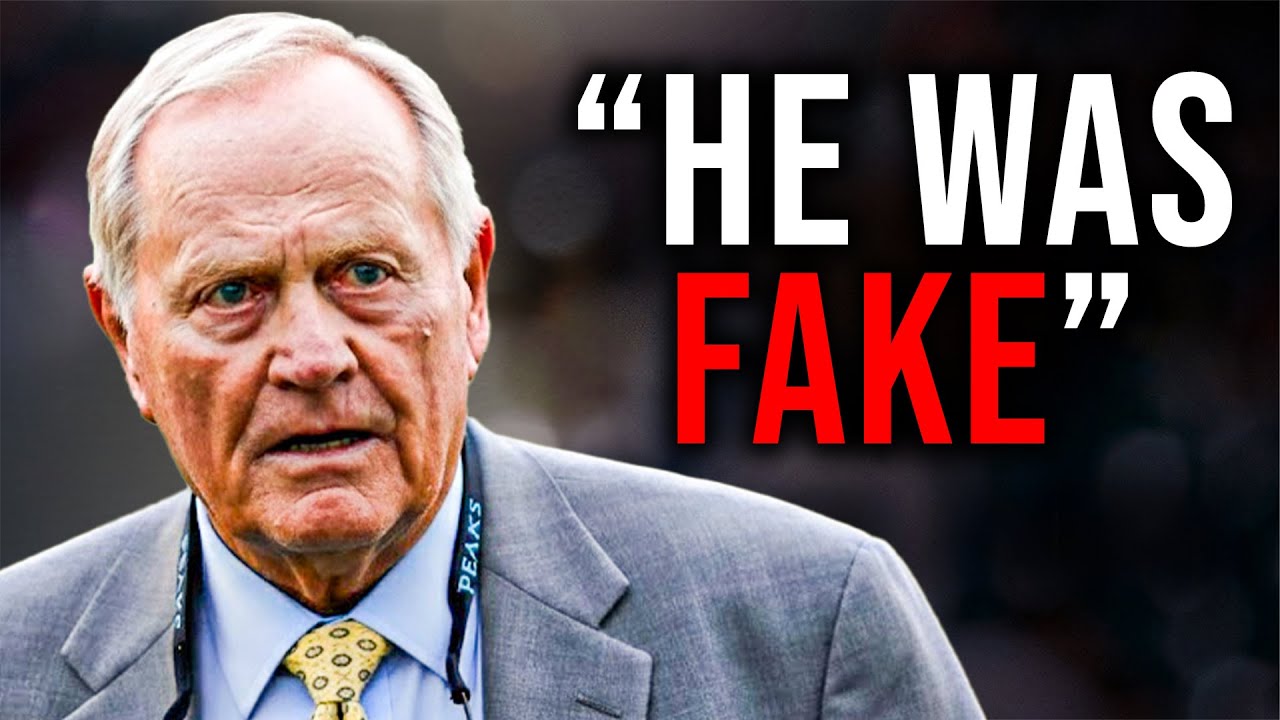
Jack Nicklaus Names 4 Golf Players He Absolutely HATED
do exactly the same thing. All I do is what makes the ball fade? Exactly the same swing. That ball hit a little bit of a slight. The stories you’ve heard about Jack Nicholas hating other golfers, they’re mostly fake. For years, people claim the Golden Bear absolutely despised four specific players who beat him on the course. But the truth is far more complicated and far more personal. Nicholas didn’t hate the guys who won majors against him. He reserved his genuine contempt for people who betrayed his trust, attacked his legacy, and compromised the integrity of the game he helped build. The real enemies weren’t on the fairway. They were in boardrooms, press conferences, and modern practices that made his blood boil. Let’s start with the most recent and most painful conflict in Nicholas’s life, his legal war with Howard Milstein. In April 2025, Nicholas secured a major victory when a New York court awarded him $1 million in damages against Nicholas Companies. This wasn’t just any business dispute. This was deeply personal. The whole mess started back in 2007 when Nicholas sold broad trademark and licensing rights to his name for $145 million. Seemed like a good deal at the time. But in 2022, everything fell apart when Nicholas Companies, led by chairman Howard Milstein, sued Nicholas himself. They claimed they owned exclusive rights to his name, image, and likeness. Basically, everything that made Jack Nicholas who he is. The court eventually ruled that while Nicholas companies kept control over corporate trademarks like the Golden Bear logo, Nicholas retained exclusive control over his name and image for personal endorsements. But the damage to their relationship was already done. Nicholas didn’t just feel wronged. He felt utterly disrespected as a human being. He said Milstein acted as if he owned him. Milstein tried to control every aspect of his life, treating him as if he was his property. Those are strong words from a man known for being measured and professional. Nicholas went on to say that despite trying hard to make the relationship work, it became obvious he had aligned himself with a person who didn’t respect him as a human being. Think about that for a moment. This is Jack Nicholas, winner of 18 major championships, a man who defined excellence in golf for decades, and he felt like someone treated him as property. The conflict didn’t stop with the NIL lawsuit either. Nicholas also filed a separate defamation lawsuit in Florida against Milstein. The lawsuit involves false claims about his involvement with LIIV Golf. This whole situation represents the first true source of hatred in Nicholas’s life. Not a competitor who beat him fair and square, but a business partner who he believes betrayed him at the deepest level. The Milstein conflict reveals something crucial about what actually triggers Nicholas’s anger. It’s not about losing on the golf course. It’s about trust being violated. When you sell the rights to your name and likeness, you’re entering a partnership built on mutual understanding. Nicholas believed there were boundaries to that agreement. He believed certain aspects of his identity remained his own. When Milstein crossed those boundaries, it wasn’t just a legal disagreement. It became a personal violation that struck at the core of Nicholas’s sense of self. What makes this conflict particularly painful is the duration. This wasn’t a one-time argument that got resolved quickly. The legal battles have dragged on for years, involving multiple lawsuits, court appearances, and public statements. Every time Nicholas thought he had clarity about what belonged to him and what belonged to the company, new disputes emerged. The mental and emotional toll of that kind of prolonged conflict cannot be understated. For someone who built his career on focus and mental toughness, having to fight legal battles over his own name must have felt like a constant distraction from everything he accomplished. Now, here’s where it gets interesting. When people talk about Jack Nicholas hating other golfers, they usually throw out names like Larry Nelson, Hail Irwin, Nick Price, and Tony Jacqueline. These were all successful major champions who competed during Nicholas’s prime years, but there’s zero evidence Nicholas actually hated any of them. The list people site are basically just guys who won tournaments when Jack was playing. Larry Nelson won three majors, but only 10 tour wins total. That doesn’t scream bitter rival. Same with the others. They were good players who had their moments, but Nicholas didn’t lose sleep over them. The truth is, Nicholas’s competitive mindset didn’t work that way. His wife Barbara once explained that his focus was consistently on victories and personal accomplishment. Breaking specific historical records like those held by Bobby Jones only became a conscious objective later in his career when reporters brought it to his attention. Nicholas had a simple philosophy. If you want to be the best, you play against the best. That’s an outward focused mindset. He wasn’t looking inward at the perceived character flaws of his opponents. He was looking at the challenge in front of him. This distinction matters because it separates Nicholas from many other dominant athletes. Some champions thrive on perceived slights and grudges. They need enemies to fuel their competitive fire. Michael Jordan famously created imaginary conflicts to motivate himself. But Nicholas operated differently. His motivation came from internal standards, not external rivalries. He wanted to shoot the lowest score possible. He wanted to win the most majors. Other players were simply part of the landscape he had to navigate, not personal antagonists he needed to defeat. That internal focus explains why Nicholas could be fiercely competitive during tournaments, but friendly afterward. He didn’t need to hate someone to want to beat them. The competition itself was enough. The challenge of executing shots under pressure, managing a course, handling the mental strain of major championship golf, those were the real opponents. Human competitors were just the mechanism through which those challenges manifested. What about the guys who really did give Nicholas trouble on the course? Let’s talk about Arnold Palmer first. The rivalry between Nicholas and Palmer is one of golf’s most famous stories. Palmer was the king. Charismatic, aggressive, beloved by galleries everywhere. Nicholas was calculated, precise, almost mechanical in his approach. When young Jack beat Palmer in a playoff at the 1962 US Open for his first major title, it could have sparked genuine animosity. Palmer’s fans actually booed Nicholas that day. But despite the massive financial and cultural stakes, their relationship remained fundamentally colleial. Palmer, Nicholas, and Gary Player delivered a combined 150 top 10 finishes in majors. They shared seven consecutive Masters titles in the 1960s. Their rivalry evolved into what everyone called a friendly rivalry. This friendship lasted long after their competitive peaks. The three of them served together as honorary starters at Augusta until Palmer’s death in 2016. That’s not the behavior of men who hated each other. That’s mutual respect between legends. The Palmer relationship actually demonstrates Nicholas’s capacity for separating competition from personal feelings. Palmer represented everything Nicholas had to overcome. He was the established star, the fan favorite, the charismatic leader who defined golf in the early 1960s. When Nicholas emerged, he was initially seen as the villain, the cold, calculating young player who threatened Palmer’s reign. The crowds didn’t embrace him the way they embraced Palmer. that could have created bitterness, but instead Nicholas used it as motivation to prove himself through performance, not by tearing down Palmer personally. Then there’s Tom Watson. The 1977 Open Championship at Turnberry. The duel in the sun might be the perfect example of how Nicholas viewed competition. On the final day, locked in a head-to-head battle, Watson turned to Nicholas and asked, “This is what it’s all about, isn’t it?” Nicholas replied, “You bet it is.” They were appreciating the extraordinary quality of their battle in real time. Watson arguably supplanted Nicholas as the dominant force in golf during the mid 1970s. He gave Nicholas some of his most frustrating defeats, but there was nothing but respect between them. The Watson dynamic is particularly revealing because it shows what Nicholas valued most. He didn’t want easy victories. He wanted to test himself against the best competition possible. When Watson was playing at an elite level, it elevated Nicholas’s own performance. That tournament at Turnberry became legendary precisely because two all-time greats pushed each other to extraordinary heights. Nicholas lost that day, but he gained something more valuable. Confirmation that he had competed in one of golf’s greatest battles that mattered more to him than the trophy. So, if competitive losses didn’t create hatred, what did? We need to look at the second major source of Nicholas’s animosity, Greg Norman. This relationship represents an ideological betrayal that cuts deeper than any lost tournament. Norman and Nicholas once had a mentor protege dynamic. Norman looked up to Nicholas as a golf icon dating back to the 1986 Masters, but that relationship completely fell apart over Live Golf. The conflict became public when Nicholas revealed he was offered a sum in excess of $100 million by the Saudis to take on a role similar to what Norman now holds. Nicholas declined. His reason pure loyalty. He said, “I have to stay with the PGA Tour. I helped start the PGA Tour.” For Nicholas, the PGA Tour isn’t just an organization. It’s inextricably linked to his own legacy. He views himself as one of its founding fathers. Walking away would have been a betrayal of everything he built. Norman didn’t take Nicholas’s decision well. He retaliated forcefully and publicly. Norman called Nicholas a hypocrite. He claimed that Nicholas had previously voiced support for the concept of the Saudibacked League. According to Norman, Nicholas had said, “This is good for our game. If it’s good for the game of golf, it’s good by me. Norman’s attack aimed directly at Nicholas’s reputation for unwavering professionalism. Calling Jack Nicholas a hypocrite in public isn’t just criticism, it’s a declaration of war. This disagreement represents a fundamental conflict over the future integrity of the sport. Nicholas sees Norman’s role as commissioner of LIIV Golf as a profound ideological betrayal of the game’s core principles. The severity of the rift is underlined by Nicholas’s reluctance to publicly elaborate on the bad blood that developed between them. When someone like Nicholas, who’s known for being diplomatic, won’t even discuss a relationship anymore, you know, something serious went down. Norman became an ideological opponent, someone who publicly attacked Nicholas while leading what Nicholas views as a threat to traditional professional golf. The Norman situation also touches on something deeper, the question of legacy and loyalty. Nicholas spent decades building the PGA Tour into what it became. He used his star power to attract sponsors, grow purses, and legitimize professional golf as a major sport. When he declined the LIV offer, he was protecting that investment. Not just the financial investment, but the emotional and historical investment. Norman accepting a similar offer and then criticizing Nicholas for declining felt like a rejection of everything Nicholas had built. What made Norman’s betrayal especially painful was the personal history between them. These weren’t strangers. They had a relationship built over decades. Norman had looked up to Nicholas. They had played together, talked about the game, shared experiences. When Norman called him a hypocrite publicly, it wasn’t just a business disagreement. It was a personal attack from someone Nicholas had considered part of the golf family. That kind of betrayal cuts deeper than anything a stranger could say. But wait, we’re only at two people so far. Milstein and Norman. Who are the other two on Nicholas’s hate list? This is where things get really interesting. The third and fourth sources of Nicholas’s contempt aren’t individual players at all. They’re concepts. They’re practices. They’re what Nicholas sees as the degradation of professional golf itself. Let’s talk about the third target of Nicholas’s hatred, the modern professional archetype. Nicholas has absolute contempt for certain modern developments in golf. While he displayed professional respect for his contemporaries, he harbors genuine fury toward practices that compromise the game’s integrity. This philosophical opposition carries the same intensity as personal conflict. In a joint press conference with Gary Player, Nicholas agreed that the practice was absolutely absurd. He argued that relying on external resources, often compiled by someone who can’t break 90, fundamentally undermines the responsibility and enjoyment of learning how to play the game. For Nicholas, mastering the subtleties of the pudding surface, is an inherent part of being a professional golfer. That skill shouldn’t be outsourced. His comments make clear this represents a philosophical failure. It suggests a lack of rigor in the modern game that he finds deeply frustrating. The Green Book issue goes to the heart of what Nicholas believes professional golf should be. In his era, reading greens was an art form. Players spent hours studying slopes, grain, and subtle breaks. They built that knowledge through experience and observation. Using a book created by someone else removes that element of skill. It turns green reading into a paint by numbers exercise. For someone who spent his career mastering every aspect of the game, watching modern players rely on external guides must feel like watching artists trace other people’s work instead of creating their own. But Nicholas’s contempt goes beyond green books. He has unequivocally stated, “I can’t stand that.” The interview on the golf course, he cited an incident where Ben Griffin, a leading golfer at the time, was interviewed while contemplating a very difficult shot from the rough. Nicholas expressed concern that such distractions totally take a player’s mind off what he is doing. To emphasize how serious this breach of competitive focus really is, Nicholas invoked Ben Hogan, one of the most intimidating figures in golf history. He asked rhetorically, “How do you think Hogan would respond to that question?” Then he answered his own question. “You would not have any teeth left if you did. He would hit you right in the face with it.” By using the Ben Hogan standard, Nicholas weaponizes a historical figure to imply moral failure. He’s saying modern players like Griffin who accept these interviews are failing to uphold professional standards. This profound institutional disdain for the deterioration of rigor and integrity provides a clear outlet for the high intensity of negative feeling that people mistakenly attribute to personal rivalries. Nicholas doesn’t just dislike these practices. He views them as threats to the game itself. The interview controversy reveals Nicholas’s views on focus and mental preparation. In his era, players guarded their concentration fiercely. They didn’t want distractions between shots. They certainly didn’t want media obligations in the middle of a round. The mental game was sacred. Allowing interruptions during competition would have been unthinkable. Watching modern players accept these interviews probably makes Nicholas feel like fundamental boundaries have been violated. The game he knew and mastered is being transformed into something he doesn’t recognize. So, the modern professional archetype represents players who use green reading books and accept mid-round interviews. They might not be specific individuals Nicholas hates, but they embody everything wrong with contemporary golf in his eyes. The intensity of his criticism suggests this is absolutely a form of hatred. Hatred for what the game is becoming. Now for the fourth source of Nicholas’s contempt, the legacy critic archetype. This figure embodies those who seek to diminish Nicholas’s historic achievements by attacking the competitive context of his era. They argue that the fields Nicholas beat were shallow. They claimed that aside from a handful of elite players, much of his week- toeek competition consisted of guys who held outside employment or weren’t full-time, highly conditioned professionals. The implication, Nicholas’s 18 majors are inflated because he played against weak competition. Johnny Miller historically exemplified this criticism. Miller was known as an outspoken and often correct commentator, but his critiques sometimes gave the impression that he believed his own opinions were infallible. Miller engaged in commentary that questioned the depth of competition during Nicholas’s prime era. He suggested that easier fields made Nicholas’s victories less impactful than they appeared. While there’s no confirmation that Nicholas personally hated Miller, this relationship provides an archetype for antagonism based on disparaging the legacy. Nicholas is highly sensitive to critiques regarding the quality of competition he faced. His entire career was built on the foundation of being the best. When people try to undermine that foundation by saying the competition was weak, it touches a raw nerve. Any attempt to diminish his 18 major championships threatens the core of his identity as a golfer. That’s why those who publicly attack his legacy, whether it’s Miller or anyone else, become sources of genuine ideological contention. The intensity of Nicholas’s reaction to these claims tells you everything. He doesn’t just disagree with legacy critics. He sees them as intellectual antagonists trying to rob him of what he earned. Protecting his hard one legacy from this kind of disparagement absolutely justifies including the legacy critic archetype on his list of hated figures. These are people who use statistics and arguments to say Nicholas wasn’t as great as his record suggests and that’s something he simply cannot tolerate. Let’s take a step back and understand why the original four hated players claim gained so much traction. The specific names that usually pop up. Larry Nelson, Hail Irwin, Nick Price, Tony Jaclyn were simply high-profile competitors who achieved notable feats during Nicholas’s prime years. Nelson won three majors despite relatively few PGA Tour wins overall. That alone shows these lists were created by people who just looked at who succeeded during Nicholas’s era and assumed there must have been personal conflict. But competitive success against Nicholas didn’t create hatred. The historical record is crystal clear on this. When players beat Nicholas fairly in tournaments, even in majors, he respected them. The origin of the four hated players claim appears to be historical speculation, filling a narrative gap. People expected a dominant figure like Nicholas to have bitter enemies. Since he was so fiercely competitive, observers sought to identify specific personal foes to match his reputation. So, they just inserted names of successful major champions from that era, regardless of any documented personal conflict. The truth is more nuanced. When a player’s motivation is rooted in raising their own standard, like Nicholas’s was, losing is viewed as a necessary setback to overcome, not a personal slight demanding retribution. Nicholas believed he possessed overwhelming superiority over most of the field during his era. When you view yourself that way, you rarely develop sustained personal resentment toward opponents. They’re simply obstacles you typically overcome, often and repeatedly. A lack of consistent frustrating parody meant Nicholas had no single peer consistently able to induce the level of bitterness required to justify the claim of absolute hate. So, where does that leave us? We have four genuine sources of Nicholas’s contempt. Howard Milstein represents personal betrayal. Someone who treated him as property and disrespected him as a human being. Greg Norman represents ideological betrayal, someone who abandoned the traditional structure of golf and then publicly called Nicholas a hypocrite. The modern professional archetype represents institutional degradation, players and practices that compromise the rigor and integrity Nicholas believes professionals should maintain. And the legacy critic archetype represents intellectual antagonism, people who try to diminish his achievements by questioning the competition he faced. None of these are traditional golfing rivals. None of them are guys who simply beat Jack in a playoff. The real hatred in Nicholas’s life stems from breaches of trust, ideological conflicts, and threats to his values. Genuine animosity requires something deeper than competitive loss. It requires betrayal, disrespect, or fundamental disagreement about principles. Think about what this reveals about Jack Nicholas as a person. His fierce competitive spirit didn’t translate into personal grudges against other golfers. He could separate the game from the person. He could battle Tom Watson in the Duel in the Sun and walk away with nothing but respect. He could lose to Arnold Palmer and still maintain a friendship for decades. That takes emotional maturity and perspective. But when someone crosses certain lines, when they try to control him, when they attack his integrity publicly, when they degrade the game he loves, when they try to erase his legacy, that’s when Nicholas draws a hard line. Those are the unforgivable sins in his world. Those are the things that earn genuine hatred. The myth of the four hated players persists because it speaks to Nicholas’s unwavering competitive temperament. People assume someone that driven, that successful, that dominant must have enemies on the course. But but the reality is more complex. Nicholas may not harbor classic golfing feuds against players who simply outscored him. But his fiercely protected integrity and traditionalism have created modern adversaries whose breaches of trust and ideological opposition fully justify intense negative feelings. Understanding this distinction matters because it reveals what Jack Nicholas truly values. He values respect between competitors. He values the integrity of professional golf. He values control over his own name and legacy. And he values the traditional structure of the game that he helped build. When any of those things are threatened, that’s when you see the full force of his personality. Howard Milstein threatened his personal autonomy and treated him as property. That’s unforgivable. Greg Norman betrayed the game’s traditional structure and called him a hypocrite. That’s unforgivable. Modern professionals who rely on green books and accept mid-round interviews compromise the rigor of the game. That’s intolerable. Critics who try to diminish his achievements by questioning his competition attack the foundation of his legacy. That’s intolerable. These are the real sources of Jack Nicholas’s hatred. Not golfers who beat him on Sundays, not rivals who won majors when he was playing, but people and practices that violate his core values. The original premise of four hated players from his competitive era is fundamentally flawed and unsupported by the historical record. The evidence clearly shows that his deepest grudges are concentrated in legal battles and ideological conflicts, not oncourse competition. The distinction between competitive rivalry and personal hatred is something modern sports fans often miss. We live in an era where athletes create drama for publicity, where trash talk is encouraged, where rivalries are manufactured for storylines. But Nicholas came from a different time. A time when professionalism meant something. When respect between competitors was expected. When you could battle someone fiercely and still shake their hand afterward. That’s why the Milstein and Norman situations hurt so much. They violated the code Nicholas lived by. Milstein violated the code by treating a business partner as property. Norman violated it by abandoning the traditional structure and then attacking Nicholas publicly. These weren’t competitive defeats. They were betrayals of trust and principle. And that’s something Nicholas cannot forgive. The modern professional archetype and legacy critic archetype represent different kinds of threats. They threaten what Nicholas built and accomplished. Every time a player uses a green book instead of learning to read greens themselves, it diminishes the skill Nicholas mastered. Every time someone questions whether his competition was legitimate, it undermines the foundation of his 18 majors. These attacks are more subtle than what Milstein and Norman did, but they’re just as damaging to what Nicholas cares about. So, when you hear someone claim Jack Nicholas hated four specific golfers, you’ll know the truth. The Golden Bears grudges run deeper than fairway feuds. They’re about betrayal, control, integrity, and legacy. They’re about defending what matters most to him, even when it costs him millions of dollars for long-standing relationships. That’s the real story of Jack Nicholas’s hatred, and it’s far more revealing than any list of competitive rivals could ever be. In the end, maybe that’s what makes Nicholas such a fascinating figure. He could compete at the highest level for decades without developing personal animosity toward his opponents, but he couldn’t tolerate betrayal or the degradation of standards he held sacred. His hostility is reserved not for opponents, but for betrayers and those who degrade the professional standard he established. That’s the legacy of Jack Nicholas, not just as a golfer, but as a man who knew exactly where to draw the line between competition and principle. And once you crossed that line, there was no going
#golfer #golfswing #golf #pga #golflife #golfing # #LIVGolf #PGATour #GolfDrama #jacknicklaus
The stories you’ve heard about Jack Nicklaus hating other golfers? They’re mostly fake. For years, people claimed the Golden Bear absolutely despised four specific players who beat him on the course. But the truth is far more complicated and far more personal. Nicklaus didn’t hate the guys who won majors against him. He reserved his genuine contempt for people who betrayed his trust, attacked his legacy, and compromised the integrity of the game he helped build. The real enemies weren’t on the fairway—they were in boardrooms, press conferences, and modern practices that made his blood boil.
Bernie Madoff , Roy Cohn , , Allen Klein , Robert Maxwell, Lou Pearlman , Milstein, Woody Allen , Weinstein Brothers and many many more all have one of a few matters in common
The headline was “absolutely hated”
Yet they have no evidence that JN thought about them .
If someone would do that to Jack Nichols, just imagine what they would have done to Tiger. If Tiger had allowed the friendship with that Aussie, Tiger could have walked down that same type of road with that snake in the grass. The best thing Tiger ever did was kept his distance from a shark.
Unfortunately, this is just a “story”. Probably, most of this is true. But, unless Mr. Nicklaus actually voices these as true, catalog this as fiction.
Glad the Milstein crap is over for Jack and his family.
Mr Nicklaus you are a class act always
Yada yada yada yada yada
Every time you say the same thing over and over.
The title is deceiving. You only named one player, Greg Norman.
Couldnt see Jack hating anybody. Always came across as being a very level headed human being.
This craze for YouTube views is pathetic. Click-bait rules the airwaves.
When money is involved you see what people are like sad.
This is very strange how the word hate is been used more today’s media, then year’s past. Why not use disliked etc. it’s growing up from parents.
Jack is a honest trustworthy person I would just him over many other people fact great man
Jack did nothing wrong trusted person
You don't win 18 majors if your not great his records will stand for ever
Great player ever
Great man ever fact
Nicklaus is a right wing hack
I had a big respect for him as a player and human until he endorsed monster Trump and give him most improved award(?) for what ,cheating. What a boot -sucker!
You know what we all hate? Nameless, faceless Youtube video which throw the word "hate" around without a shred of evidence to support the accusation. Enough already.
Golf used to be an individual sport. Not a team sport. Maybe a swing coach. The guys back in the day, could really play. Most of them swing like robots now, not like golfers
Jack Nicklaus And Tiger Woods Said No 2 Liv Golf