

パッティングのスピードコントロール方法 | フィル・ケニオン 第7~9週
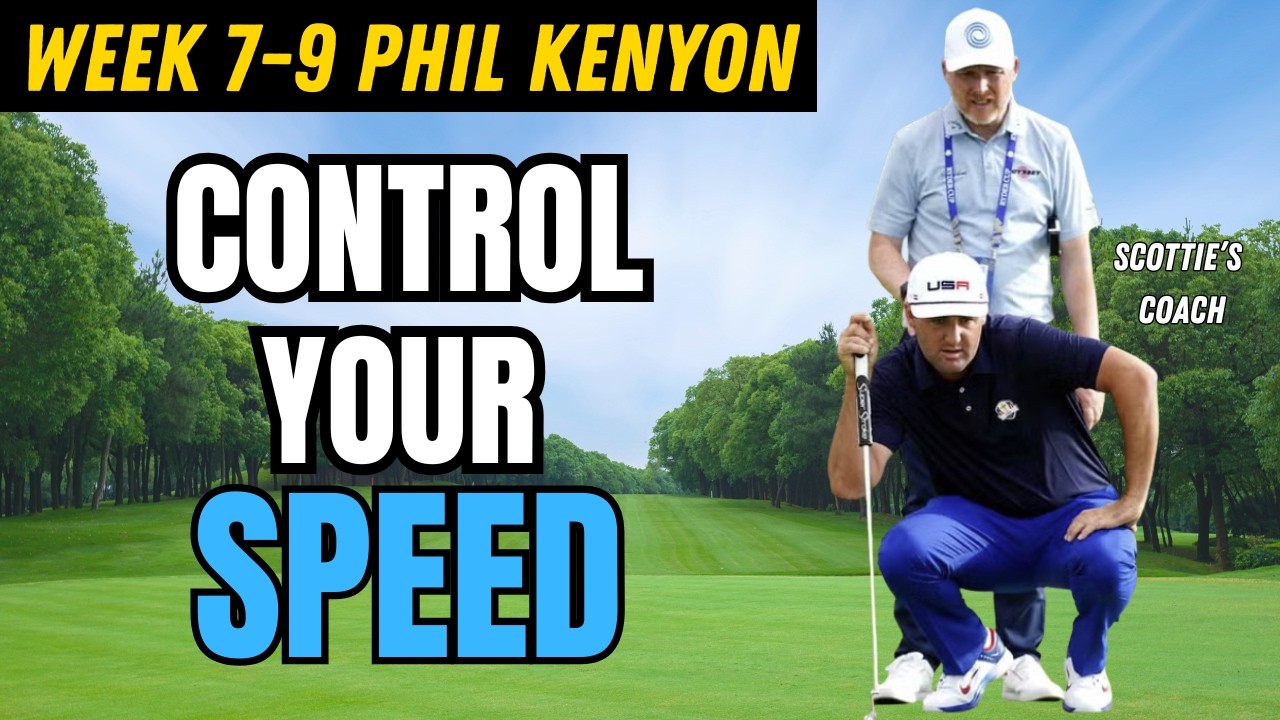
We’re going to look at speed control today and this is all from week seven to nine of Phil Kenyon’s putting academy. Phil Kenyon coaches Scotty Sheffler, Tommy Fleetwood, Justin Rose on their putting and he’s kind of the guru these days. Um, so I signed up for his course. I’m going to walk through the four basic concepts Phil talks about in terms of speed control and then two drills that I think are, you know, pretty simple but will dial in your speed control. So, those will be at the end. So, watch for those. Uh the first one is about the segments of your body. So he talks about segments that move independently. If you want to keep consistent speed, you got to kind of limit because you’re dealing with short distances here. Limit the moving parts. So you kind of lock in the bottom part of your body, the legs, the hips, and kind of just turn around your torso. The hands are going to move a little bit, but just naturally because of the weight of the club. So you kind of got to lock in the segments to get proper speed control. The second thing is, you know, where you’re hitting it on the putter face. If you’re hitting in the center every time, you’re gold, but if you’re hitting heel and toe, it’s going to affect the speed. Uh, generally, it’s going to be shorter. Not to mention directionally, it might be off. Uh, so you got to work on that strike. And we talked a lot about that in the last video. So, look back on those videos if you want to see more about proper strike. Uh, the third thing is the biggest is rhythm and timing. Pro golfers generally have a a 2:1 ratio on length of time it takes them to go to the top of their back swing on the putt to impact. 2:1 ratio and it’s actually 66 seconds going back on average and 33 coming down for about a second uh on on putting strokes on average on the tour. There’s going to be some faster, there’s going to be some slower, but generally that is the motion. And and Phil talks a lot about the pendulum. same amount going back, same amount going forward. And the timing of it is, you know, it’s like a metronome. Tick, tick, tick, tick. And we’ll go through that in some of the drills. The fourth concept, which rhythm and timing addresses, is acceleration. And this was a bit of a mind-blowing thing for me. You’re not continually accelerating into a putt. I grew up thinking, you know, we had to accelerate, which led to a short back swing and a long follow through as I accelerate, trying to control the speed that way. But what pro golfers do is they actually go to the top of their back swing. They’re accelerating going down at first and then they’re almost on cruise control at the bottom. They might be slightly accelerating very consistently and then they hit the ball and it starts slowing down, but they’re not continually accelerating at a faster pace. They’re actually on cruise control at the bottom. Here’s Phil from his YouTube channel. But what you can control and I think what players sort of um resonate better too is rhythm and timing and swing length balance. So here’s a great concept for you to have which I think will help you um control your rates of acceleration. But a good concept for me is for the uh the back swing and the forward swing to be of equal length. And also then we want the rhythm of the stroke to be close to a 2:1 ratio. So the the the length of the uh the length of time the back swing takes the down swing to impact is going to be half of that. So for example, if we were 66 milliseconds back, we’d be 33 milliseconds down. Now, if we can work on feeling a nice equal pace of stroke back and through with a nice equal length, then for me, we will start to control acceleration. So, that’s a bit of a eye openener. You know, kind of explains why I’m always off on my putts. I’m often short uh or really long. There’s like no in between. Just to bring it all home, here’s Ben Crrenshaw, one of the best of all time on his thoughts on putting and rhythm and timing. Remember, you want to use the same tempo every time. The only variable is the length of your back swing. And the length of your back swing will determine how hard you hit the ball. So, let’s now get to the drills. So, really, we just need two drills to kind of drill in Phil Kenyon’s uh concepts on speed control. The first one is using a metronome. And I’m going to click on a metronome here and just show you the drill quickly uh that you can practice at home. And then we’re going to go to the course and I’ll show you the next drill, which is great for just dialing in the distances. So, I clicked on 80 beats per minute. It’s a YouTube video. There’s apps as well you can use on your phone. And we’re just trying to build a stroke to go with that 80 beats per minute. You might be 90, 85, whatever. You got to kind of experiment with that. This one works for me. And I’m trying to hit the end of the backstroke on a beat and then follow through on a beat. And now this is how you get consistent speed because that putter basically has to be moving at the same speed every time with that length stroke. And when you you’re hitting it a little bit further, you got a longer putt. Timing is exactly the same. Same timing, but that putter is moving faster because it’s it’s all based on the distance of the back swing. Great drill. This is how you ensure you get consistent speed. and then you got to take it to the course. And that’s what we’re going to do in the next video. So, you can definitely just use a metronome. Uh if you do have a hack motion though, there’s a couple of good drills in uh in there. I’ll just show you one of them. Change the beats per minute to 80, which is what I like. And this is just the rhythm and time, one of the rhythm and timing drills, but it’s a beauty. So, [Music] So you’re trying to hit that 80 80 beats per minute and then you try to get that 2:1 ratio with that same rhythm. That seemed a little fast. Yep. A little better there. 1.9. This is all built into Hack Motion, but just use a metronome if you have it. If you have a hack motion, uh, use it for this. It’s awesome. I’ll put a link if you want to read more about it in the description. We’re going to set up the second drill here. Really, you just have to step out. You can do five, 10 ft, whatever. I’m going to do six feet here. So, we got a sixoot putt. And then we got another six feet. The goal in this drill, and it’s all about speed, uh, is to basically get the putts just past this first peg. And then the next one, you want to get just past that. And then the next shot you want to get just past that. And so on. And you try to see if you can get, you know, six to eight balls in this little gap, always passing the ball before it. So just so I just got past it. Well, that would have been past it. Well, it is past it. Got to make sure you don’t hit it either. So sometimes I’ll just place them aside so I don’t keep hitting them. And then you continue on each time a little bit further. And that one’s a big one. So, I got to somehow get some more balls in here. This is called the ladder drill. I didn’t like that stroke either too much. But you can see after you continually do this, and you would do it uphill, then you do it downhill. Uh you’d slowly build your stroke. Just pass. That’s a good one. You still slowly build that speed control. That one might not make it. Yeah, just made it.
⛳ Resources
🎥 HackMotion Sensor (Affiliate Link): [https://hackmotion.com/?aff=136]
OR CODE: lmh5
I use HackMotion for putting tempo and timing (also great on full swing) — it’s the best way to see what your putting stroke is really doing.
🎓 Phil Kenyon’s Putting Academy (NOT affiliated with Phil Kenyon at all): https://www.philkenyonputtingacademy.com
Phil Kenyon coaches players like Scottie Scheffler, Tommy Fleetwood, and Justin Rose. His 12-week course transformed how I approach putting.
📖 About This Video (Weeks 7–9 Summary)
In this video, I review Weeks 7–9 of Phil Kenyon’s 12-Week Putting Academy — focused entirely on speed control.
You’ll learn the four key concepts that affect putting pace:
1️⃣ Segment motion & coordination – how your torso, arms, and wrists combine to create speed.
2️⃣ Rhythm & timing – the 2:1 tempo tour players use for consistent distance control.
3️⃣ Acceleration profile – why constant acceleration isn’t the goal.
4️⃣ Strike quality – why center contact determines both speed and direction.
Then, I’ll walk you through two drills that helped me apply those concepts right away:
✅ Metronome Drill – to train consistent rhythm and tempo.
✅ Ladder Drill – to build “speed skill” and match pace to slope and break.
If you struggle with putts coming up short or racing past, these concepts will change how you practice — and how confidently you roll every putt.
🧰 Additional Resources
[HackMotion Sensor](https://hackmotion.com/?aff=136) – measure rhythm, timing, and wrist angles for putting.
Phil Kenyon’s Youtube Channel: @philkenyonputting
Derek Uyeda’s Leapfrog Drill: https://www.youtube.com/watch?v=9cdxGaKkluo
🗂️ Series Playlist
📍 Week 1 – Aim Check → [https://youtu.be/lJCkHrgIqV8]
📍 Weeks 2–3 – Fix Your Aim Bias → [https://youtu.be/rYWWFIHS63E]
📍 Weeks 4–6 – The 90% Secret to Putting Straight → [https://youtu.be/ZJZLfAK0V8o]
📍 Weeks 7–9 – Speed Control (this video)
📍 Weeks 10–12 – Green Reading & Touch Under Pressure → coming soon
💬 Join the Conversation
What’s the hardest part of speed control for you?
Comment below — I read and reply to every one.
I have a feeble 66 year old g’mate in my foursome, with a door prize $29.50 No’Brand Name (actually 🚫 name) putter from 1977.
Rock 🪨 hard grip. 34.5” Aluminum head, skinny steel shafted 🤷🏻 really generic plumbers neck. Anser style.
Phenomenal results 🙇
I own 40+ putters. He has no desire to take one out 4a day.
Fvcking astounding 🤯 here.. meet GawdDamn infuriating 😠