



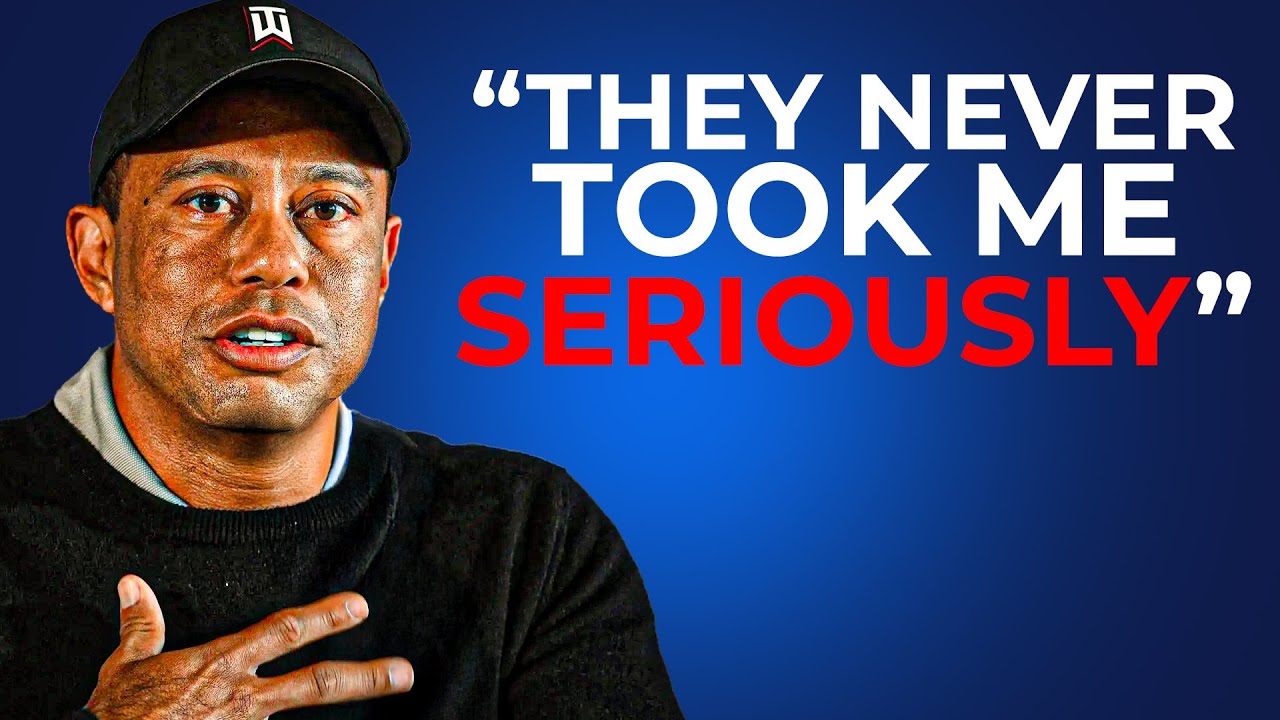
タイガー・ウッズを過小評価していた4人のゴルファー
They never took me seriously. That’s what Tiger Woods would say about the golf establishment that doubted his revolutionary ambition from day one. But four golfers learned the hard way that underestimating Tiger came with devastating consequences that would define their careers forever. When Tiger burst onto the professional scene in the mid 1990s, he wasn’t just another talented golfer. He was an unprecedented force whose ambition fundamentally challenged everything the conservative golf world stood for. The old guard had governed the sport for decades, focusing on maximizing earnings and respecting high finishes. Tiger openly dismissed these long-held values with one simple declaration that would change everything. The skepticism voiced by Tiger’s peers reflected a wider reluctance within the conservative golfing institution to fully embrace a young, radically ambitious superstar. For the establishment that had controlled the sports direction, Tiger represented an aggressive new force that threatened their cultural equilibrium. The early encounters also carried uncomfortable undertones that reflected the historical challenges faced by black golfers in the sport. Curtis Strange embodied the skeptical establishment when he first encountered Tiger’s raw ambition. In 1996, before Tiger even turned professional, the young phenom made a statement that shocked the golf world. Second place sucks. This aggressive philosophy was completely foreign to professional golf’s established decorum. Players traditionally respected good finishes and gradual progress through the ranks. Strange, a seasoned champion representing the old competitive order, responded with institutional authority. You’ll learn his response came from a deep belief that professional golf’s grind would inevitably humble Tiger’s amateur confidence. The travel, pressure, and consistent field strength would temper this young man’s unrealistic expectations. Strange presumed Tiger would be humbled by time and struggle like every other rookie before him. This public exchange instantly positioned the conflict as a definitive clash of generations, encapsulating the institutional skepticism toward Tiger’s unprecedented arrival and self asssurance. But Tiger had other plans. The timeline between Strange’s skepticism and Tiger’s response was brutally short. Less than one year after that interview, Tiger won the 1997 Masters by a record-breaking 12 strokes. This wasn’t just a victory. It was a statistical tsunami that instantly invalidated Strange’s prediction and proved Tiger’s philosophy correct. The overwhelming margin established that Tiger’s path wasn’t about gradual professional learning. It was about immediate revolutionary dominance. The key factor was the sheer velocity of Tiger’s validation. The period between Strange’s skepticism in 1996 and Tiger’s victory in April 1997 was too brief for established figures to process intellectually. Strange’s eventual public reflection and regret confirmed that the established paradigm had shifted forever. Tiger had turned their exchange into a foundational myth of his psychological power over the entire field. This episode established a core competitive theme. Any projection of conventional limits onto Tiger would be met with swift, overwhelming, and public contradiction. This is just the beginning of how Tiger systematically dismantled anyone who dared question his greatness. If you’re enjoying this deep dive into Tiger’s psychological warfare, hit that subscribe button and comment below about which rivals downfall surprised you most. The doctrine of retribution Tiger established would reach its most explicit demonstration 9 years later at the 2006 Matchplay Championship. Steven Ames thought he could gain a psychological edge by publicly critiquing Tiger’s game. Ames noted Tiger’s tendency toward weward driving, dismissively commenting, “Anything can happen, especially where he’s hitting the ball.” This constituted a direct attempt to plant doubt and exploit what Ames saw as a weakness. The fatal miscalculation was ignoring Tiger’s capacity for motivational amplification. Match play is inherently psychological, and Tiger channeled that public critique into focused competitive fury. The result was the most memorable beatdown in modern professional golf. Tiger secured victory nine holes up with eight holes left to play. He needed only 10 holes to finish aims, delivering what became known as the single biggest beatdown ever seen in modern match play. The 9 and8 margin was the largest possible in 18-hole matchplay format. Following this dominant performance, Tiger offered postround confirmation that left zero doubt about his intentions. When asked if there was inspiration beyond his love for matchplay, Tiger replied, “Oh yeah, there certainly was.” Steven provided it. So yeah, definitely. I think he understands now. This quote deliberately confirmed that the comprehensive punishment was a direct response to Ames’s offense. The perfect score served as competitive execution, maximizing humiliation, and turning Ames’ attempted mind games into a cautionary tale for the entire field. Tiger had established an invisible boundary. Competitors couldn’t afford to criticize him, even when technically accurate. This mechanism granted Tiger an immense psychological advantage before competition even began. rivals became deterred from challenging him verbally or tactically, knowing the consequences could be career-defining embarrassment. The Ames incident enforced a new reality where even accurate technical criticism became forbidden territory. But Tiger’s dominance didn’t just humiliate individual critics. It systematically overshadowed generational talents who had the misfortune of competing during his absolute peak. Ernie L’s perfectly represents this tragic dynamic. L was a major winner and world-class competitor capable of dominating any other era. Yet his career coincided exactly with Tiger Zenith. El’s became the designated foil, the one competitor who consistently finished closest to Tiger, but remained perpetually unable to overcome him in crucial battles. He experienced several close calls and major statistical deficits that solidified his role as the perpetual runnerup. The competitive dynamic between Tiger and L’s reached its absolute low point at the 2000 US Open at Pebble Beach. Tiger achieved a record 15 stroke victory, a margin of superiority not seen on the PGA Tour since 1948. L’s finished at three strokes over par, while Tiger finished at 12 strokes underpar. This result transcended mere victory. It was statistical annihilation that redefined what success meant in major championships. For any other player, achieving plus three in a US Open represents respectable performance. But losing by 15 strokes transformed this respectable result into competitive irrelevance. Tiger effectively normalized an abnormal statistical standard. By achieving victory margins unseen since the 1940s, he imposed a massive psychological barrier on the entire field. He created an expectation of perfection where anything less was doomed to statistical irrelevance, regardless of a rival’s actual game quality. The overwhelming nature of this win led competitors to attribute Tiger’s performance to something beyond technical skill. Yesper Parnick, who played with Tiger during the first two rounds, suggested Tiger possessed Jedi powers, implying he could pretty much will the ball in the hole. Such terminology suggests the field had mentally conceded the possibility of technical parody, attributing Tiger’s dominance to almost mystical advantage. This statistical imposition created sustained mental pressure that separated Tiger’s rivals into two categories. Those who could harness it for motivation and those who couldn’t escape the shadow. L’s fell into the latter group. His achievements chronically overshadowed despite worldclass play. Perhaps the most tragic victim of Tiger’s dominance was David Duval. One of Tiger’s original rivals who briefly reached world number one. During the late 1990s and early 2000s, they had a healthy rivalry that fans expected to last much longer than it ultimately did. Duval had an effective and precise swing technique that junior golfers emulated alongside Tiger’s own swing. His strong foundation and results, including ranking first in both total driving and greens in regulation in 1999, suggested he possessed the technical ability to achieve competitive equilibrium with Tiger. But Tiger continually elevated professional golf’s boundaries through unprecedented athleticism and distance gains. The pressure to keep pace to achieve competitive outcomes rather than just high finishes compelled Duval to attempt re-engineering his successful existing technique. This relentless pursuit of enhanced performance placed significant and unsustainable stress on Duval’s mechanics and physical frame. While genuine physical ailments, including injuries and debilitating vertigo, played clear roles in his decline, the continuous psychological pressure and need to push physical limits to match Tiger’s output, likely contributed significantly to the frequency and severity of these chronic breakdowns. The structural failure of Duval’s game is objectively demonstrable through the stark collapse of his key ball striking metrics. The relentless demand for continuous superiority proved too great a burden, initiating catastrophic technical decline that began sharply in 2001. Duvall’s total driving rank plummeted from first in 1999 to 191st in 2008, indicating complete collapse in both accuracy and effective power. Similarly, his greens and regulation rank fell catastrophically from first in 1999 to 197th by 2008, confirming that his iron play precision had been obliterated. This immediate and drastic statistical regression provides powerful evidence that competing against Tiger led to chronic technical and physical failure. Duval’s trajectory represents the most tragic outcome of the competitive burden Tiger imposed. He achieved the sport’s pinnacle with excellent technique. Yet, his subsequent breakdown confirms that against Tiger, mere excellence was insufficient. The analysis of these four cases confirms that Tiger’s dominance created profound competitive polarization. Tiger functioned either as an accelerator of pre-existing talent or as a destroyer of competitive frameworks. Highly resilient players like Phil Mickelson credited Tiger with forcing them to elevate their games, openly acknowledging that intense competition demands improvement. Conversely, Tiger fundamentally destroyed the competitive framework of those who underestimated him or couldn’t maintain the pace. Strange’s philosophical underestimation resulted in immediate repudiation and his era’s obsolescence. Ames’s tactical hubris resulted in public humiliation through record- setting retribution. Elsa’s statistical inability to compete meant his achievements were chronically overshadowed. Duval’s physical decline illustrated the ultimate adaptation failure, proving the cost of parody with structural breakdown. Tiger’s consistent, overwhelming victories established a doctrine of inevitability in professional golf. His presence fostered a belief system where rival victory became less about exceptional play and more about waiting for rare Tiger mistakes. This psychological standard meant rivals entered events already at competitive deficits, fearful of triggering the retribution mechanism and dreading statistical irrelevance. Tiger’s career forced golf to become younger, significantly more athletic, and globally minded at an accelerated pace. The four golfers detailed aren’t simply footnotes to Tiger’s extensive records, but essential case studies illustrating the severe human cost of competing against a truly revolutionary figure. The evidence uniformly demonstrates that underestimating Tiger, regardless of form, guaranteed severe competitive consequences. His dominance didn’t just change golf, it fundamentally broke those who dared challenge his greatness. If this analysis opened your eyes to Tiger’s psychological mastery, smash that like button, subscribe for more deep dives, and comment about which rivalry you think had the biggest impact on golf history.
#golfer #golfswing #golf #pga #golflife #golfing # #LIVGolf #PGATour #GolfDrama #curtisstrange #tigerwood #stephenames #davidduval #ernieels
“They never took me seriously.” That’s what Tiger Woods would say about the golf establishment that doubted his revolutionary ambition from day one. But four golfers learned the hard way that underestimating Tiger came with devastating consequences that would define their careers forever.