


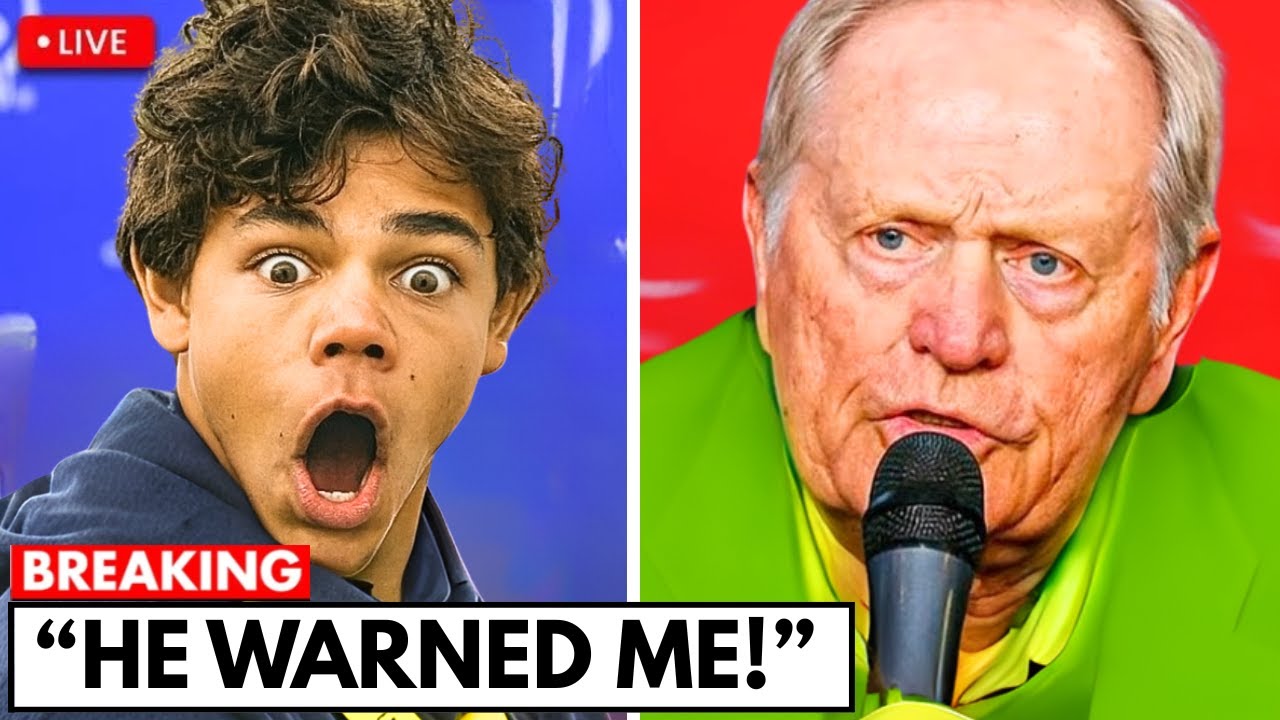
チャーリー・ウッズがついにやってしまった & ジャック・ニクラウスが緊急警告を発令!
win. This was the breakthrough. From the very start of the tournament, Charlie’s game looked sharp, controlled, and fearless. Each swing carried that same effortless tempo fans remember from his father’s prime. Yet, there was a distinct stamp of individuality. He strung together birdies, stayed patient through the inevitable challenges, and closed with a dominant underpar finish. It wasn’t a squeaker, it was a statement. Securing victory by multiple strokes against a field stacked with the best young players in the country sent one message loud and clear. Charlie Woods isn’t here to blend in. He’s here to win. The ripple effect was immediate. Overnight, his position in the Junior World Rankings rocketed upward, vaultting him into the conversation for the sport’s most prestigious upcoming events. For any teenager, this would be career-changing. For the son of Tiger Woods, it meant stepping into a spotlight that had been waiting for him since the day he first picked up a club. Tournament directors took notice. Invitations to Elite Championships started coming in, and fans began to speculate about what could come next. And yet, beyond the numbers, beyond the trophies, the real story was in the atmosphere. Crowds followed every hole. Media lined up for quotes. And fellow players felt the weight of his presence. In one weekend, Charlie didn’t just win a title. He shifted the narrative. For years, the question was if he could ever emerge from his father’s shadow. Now, after this breakthrough performance, the golf world had its answer. The celebration had barely settled when another voice entered the conversation. And it wasn’t just any voice. It was Jack Nicholas, the Golden Bear himself, a man who knows more than most about what it means to dominate golf and live under the relentless eye of the public. Where others were cheering, Nicholas brought something different, a warning. His words didn’t come from cynicism or doubt, but from a lifetime of experience watching the game, the fame, and the weight that comes with both. The road ahead is tough, Nicholas cautioned. He wasn’t talking about competition alone. when he meant the invisible battles, the kind that can’t be measured on a scorecard. For the child of a sporting icon, the journey is never just about skill. It’s about enduring constant comparisons, impossible expectations, and a spotlight that never fades. These challenges, Nicholas knows, can break even the most talented young athletes if they aren’t prepared. Nicholas’s warning wasn’t abstract. It came from a deeply personal place. Decades earlier, his own son Gary was thrust into fame at just 16, plastered on the cover of Sports Illustrated with the bold label The Next Nicholas. Instead of launching a legendary career, that moment became a turning point and not for the better. The pressure, the endless attention, the sense that every swing was under scrutiny, it all became too much. Gary eventually stepped away from the competitive grind. Proof that talent alone doesn’t protect you from the weight of expectation. That’s why Nicholas sees Charlie’s moment as both inspiring and dangerous. The victory shows his potential. The attention shows the challenge ahead. And in today’s era where social media amplifies every highlight, every mistake, and every opinion, the intensity is magnified beyond what Gary ever faced. Charlie’s rise is undeniable, but so is the spotlight. Nicholas’s words are both a caution and a gift. A reminder that the path to greatness isn’t just walked with a golf club, but with resilience. In golf, pressure can be invisible, but for Charlie Woods, it’s impossible to ignore. Every swing he takes, every putt he makes is watched, recorded, and compared to one of the greatest players in history, his father. And father noun. For most juniors, the gallery might include parents and a handful of friends. For Charlie, it’s a wall of cameras, reporters, and fans all waiting to see if he’s the next Tiger. That expectation doesn’t just follow him, it surrounds him. In the modern era, the spotlight burns hotter than ever. When Gary Nicholas faced pressure in the 82nd, the media cycle had pauses. There were breaks between tournaments, moments to breathe. Today, the coverage is constant, fueled by social media feeds, viral clips, and instant commentary from millions of voices online. One great shot can trend worldwide in minutes. One bad round can do the same. There’s no place to hide and no chance to quietly develop in the shadows. Nicholas himself has acknowledged that this is an entirely new battlefield. He’s quick to praise Charlie’s beautiful golf swing and poise under pressure, but he also questions whether the teenager can truly grasp the magnitude of what’s ahead. It’s not just about hitting fairways. It’s about learning to navigate an environment where critics, comparisons, and expectations never rest. The mental game now extends far beyond the golf course. The irony is that Charlie’s own success fuels the very challenge he must overcome. The more he wins, the bigger the headlines. The bigger the headlines, the greater the scrutiny. It’s a cycle that can inspire or exhaust depending on how it’s managed. For Charlie, mastering his craft will be only half the battle. The other half will be building the mental resilience to carry the Woods name without letting it crush him. And in the eyes of those who’ve walked this path before, that might be the greatest test of all. For Tiger Woods, this isn’t just about raising a champion. It’s about raising his son. He knows better than anyone how unforgiving the world of golf can be, how quickly praise can turn into criticism, and how the demands of the game can consume every part of a life. That’s why even in the glow of Charlie’s victory, Tiger’s message has stayed consistent. Let Charlie find his own way. Winning is important, but loving the game is essential. Tiger’s role is a delicate balancing act. He’s a mentor with unmatched experience, but also a father who understands the risks of pushing too hard too soon. Instead of chasing every tournament, Tiger carefully chooses where Charlie competes, weighing the challenge of the field against the benefits of rest and growth. It’s a strategy built not just for short-term wins, but for building a career that lasts. Shielding Charlie from unnecessary distractions is part of the plan. While the spotlight is impossible to escape completely, Tiger works to control its intensity. Interviews are limited, media opportunities are selective, and the emphasis is always on preparation and improvement rather than publicity. For Tiger, protecting his son from burnout is as much a priority as helping him shave strokes off his game. At the heart of it all is a shared understanding between father and son. They’ve walked fairways together since Charlie was old enough to grip a club, and they’ve faced pressure-packed moments as a team. But now, as Charlie steps into the competitive world on his own, Tiger’s role is shifting from leading every step to letting him take the lead. It’s a transition filled with pride, caution, and the hope that the lessons Tiger learned in the toughest moments of his career will give Charlie the tools to write his own story. The victory may be in the books, but for the sun was just beginning to burn away the morning haze over Valhalla Golf Club, and the tension in the air was thicker than the Kentucky humidity. Charlie Woods, sitting in solo second after three blistering rounds, looked calm on the outside, but inside, every swing, every putt, every decision carried the weight of a dream. The US Junior Rider Cup, one of two automatic spots was still up for grabs, and all he had to do was hold his position. Sounds simple, but in golf, especially with history on the line, nothing ever is. Could this be the moment he finally stepped out of his father’s shadow? For three days, Woods had been electric, smooth off the tea, dialed in with his irons, fearless with the putter. The galleries buzzed with every birdie. Reporters whispered about the inevitability of his selection. Fans penciled his name onto the Rder Cup roster, but golf doesn’t respect expectations. The Junior PGA Championship is one of the purest pressure cookers in junior golf. And with Valhalla’s tight fairways and treacherous greens, the course doesn’t just test your swing, it tests your soul. Would his poise hold for just 18 more holes? The answer came faster than anyone expected. A bogey on four, another on six. The swing that looked so loose now seemed rigid. Then came the dagger, a double bogey on the back nine that drained not just the leaderboard, but the energy from the crowd following him. By the time Woods walked off the 18th green with a 74 plus three, the math was brutal. Solo second had turned into T9. And with it, the automatic Rder Cup ticket slipped away. Just like that, could momentum this strong really vanish in a single round. Meanwhile, miles away in more ways than one, Miles Russell’s seasonl long consistency paid off. Already leading the AJA points list, Russell didn’t need a dramatic finish at Valhalla to secure his spot. His place on the US Junior Rider Cup team was confirmed the moment Woods stumbled. Russell’s smile in the postround photos told the whole story. While Charlie’s dream took a gut punch, Miles’s path to Rome was clear. But if you think this was the end of their story, you’re wrong. Because for Woods, this wasn’t a knockout. It was just the start of a fight he wasn’t ready to lose. What comes next could change everything. While Charlie Woods walked away from Valhalla with questions swirling, Miles Russell left the 2025 season with answers and plenty of them. If Woods’ story in Kentucky was one of a sudden collapse, Russell’s was the steady climb of a player who seemed born for this stage. Week after week, tournament after tournament, Russell didn’t just contend, he closed. As the AJA points leader, he’d built a resume so airtight that one bad week couldn’t touch it. His worst finish in months was still better than most players best. This wasn’t a hot streak. It was a statement. And statements like that don’t go unnoticed in RDER Cup selection rooms. Could Woods ever match that level of consistency in time? The numbers don’t lie. Russell’s season included top finishes in the AJA’s flagship events, a runner up at the Northeast Amateur, and steady pressure rounds in every junior major he touched. When the Rydercup.com announcement dropped Russell and asterisk tally to lead team USA, it felt less like news and more like confirmation of what everyone already knew. This wasn’t just about his swing mechanics or course management. It was the way he carried himself. Calm, calculated, always in control. In junior golf, that’s the difference between being a name in the field and being the name on the trophy. But what happens when the comm gets challenged? His new role as co-leader with tally only amplified the spotlight. The media hailed them as the future of US junior golf. The duo set to bring dominance back to the stars and stripes. That kind of label can be both a crown and a target. For Russell, it meant respect. For Woods, it meant the bar had just been raised and dramatically. To earn a captain’s pick now, he couldn’t just play well. He had to play better than the guy already carrying the flag. Could Russell’s presence be the fuel Charlie needed? The irony. While Russell’s seat on the team is locked, his grip on the role of undisputed leader might not be. Golf history is full of sure things undone by a single inspired run from someone with nothing to lose. Woods’s road just got steeper, but in sports, steep climbs make for the best stories. And the next battleground for both players was already looming on the calendar. Would Russell keep the crown or would Charlie start prying it loose at Sawrass. For Charlie Woods, the days after Valhalla weren’t about licking wounds. They were about sharpening weapons. The disappointment of missing the automatic Rder Cup spot could have been the chapter that defined his 2025 season. Instead, it became the catalyst. Close friends said he was back at the range within 48 hours, grinding through practice sessions that stretched until the last rays of daylight. This wasn’t just about fixing a swing flaw or fine-tuning a pudding stroke. It was about proving to himself and to everyone else that Kentucky was an exception, not the rule. Redemption wasn’t a concept. It was a deadline. And the clock was already ticking. Would he hit zero before the RDER Cup roster locked? That deadline came with a name, the Junior Players Championship at TPC Sawrass. Known for its island greens, swirling winds, and unforgiving sightelines, Sawrass doesn’t allow passengers you either command the course or it drowns you. More importantly, it was one of the last major stages before the US Junior Rider Cup selectors finalized their picks. For Charlie, it wasn’t just another tournament. It was a proving ground. every hole, every shot, every fist pump would be judged in the shadow of the Rder Cup conversation. Could he turn a Florida fairway into his personal courtroom? And here’s where the drama tightens. Miles Russell would be there, too. Same fairways, same pin positions, same gallery. Only difference, one of them was already wearing the unofficial captain’s crown. The other was fighting for a seat at the table. This was more than a leaderboard battle. It was about rewriting the story Russell had been starring in all season. If Woods could outplay him here, it would plant a seed of doubt in every selector’s mind. Maybe the uncontested leader wasn’t so uncontested after all. Could one week at Sawrass dismantle months of dominance? The stakes couldn’t be clearer. For Woods, this wasn’t about a paycheck, a trophy, or even bragging rights. It was about changing the conversation, flipping it from Russell’s team to who’s leading this team. And in golf, perception can be as powerful as performance. The fairways of Sawrass were set. The wind was unpredictable, and Charlie Woods was walking in with one mission to make the RDER Cup selectors question everything they thought they knew. The opening t-shot was coming. The question was, whose story would it start? Strip away the headlines, the hype, and the slow motion highlight reels, and golf comes down to cold, unforgiving numbers. On paper, Charlie Woods 2025 has had moments of brilliance. his breakthrough victory at the AJGA team tailor made invitational where he posted a blistering final round to seal the title. The back-to back 66 second that launched him into second place at the junior PGA Championship before the final round stumble. These are the peaks that turn heads, but they’re also the kind of peaks separated by long valleys, stretches where the scoreboard told a different story. The pattern is clear. Woods can catch lightning, but can he bottle it? That’s the question selectors can’t stop asking. On the other side of the ledger sits Miles Russell and his numbers read like a metronome.
Charlie Woods JUST DID IT & Jack Nicklaus Issues URGENT Warning!
#golf #progolfer #sports
For business inquiries, copyright matters or other inquiries please contact us at: businessworklive@gmail.com
• Under Section 107 of the U.S. Copyright Act, fair use allows for criticism, commentary, news reporting, teaching, scholarship, or research without infringing copyright.
• This video may include copyrighted clips, images, or photos without specific permission, but we believe our use is legally protected under fair use.
• If you have any copyright questions or issues you can contact us at : businessworklive@gmail.com
Kid plays well, but not money making well. No chance going pro.
My 15 year old son will smoke Charlie.