



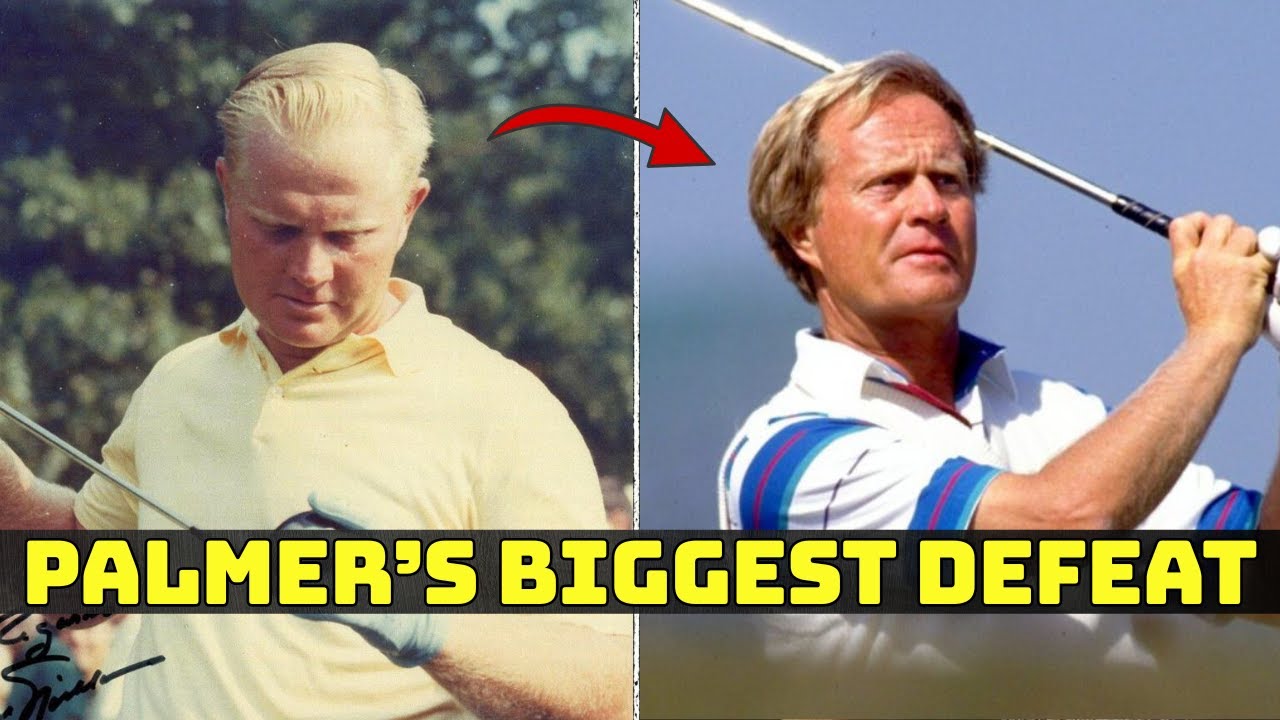
There Will Never Be Another Jack Nicklaus
[Music] At Oakmont in 1962, Jack Nicholas faced Arnold Palmer. Most of the crowd cheered for Palmer, the local hero. For Nicholas, every step he took was met with jeers and mocking voices, calling him Fat Jack. He was not only facing one of the greatest golfers in the world, but also the doubt of thousands of fans. In that difficult moment, Nicholas answered with victory, beginning his journey to become one of the greatest champions in golf history. Before following the journey of Jack Nicholas, make sure to subscribe to the channel to discover the most memorable stories of legendary golfers. In the early years of Jack Nicholas’s career, his presence on the course was constantly measured against one man, Arnold Palmer. Palmer was adored as the king, a figure who seemed to embody everything the public wanted in a champion. He was charismatic, lean, and magnetic. The kind of athlete who drew crowds not only for his game, but for his personality. People cheered his walk, his smile, even the way he carried his clubs. Nicholas, in contrast, was a different sight. He was young and broadshouldered, his frame heavier than the slender Palmer. To many fans, he looked out of place beside the lean king they adored. The galleries did not embrace him with affection. Instead, they tagged him with the cruel nickname, “Fat jack.” Those two words were not a light-hearted joke. They were a stinging reminder that Nicholas was not the chosen favorite of the crowd. This label followed him everywhere. In press rooms, in casual conversations among fans, and especially at tournaments where Palmer’s supporters were loudest, Fat Jack became shorthand for mockery. The name carried with it an assumption that Nicholas was too mechanical, too serious, and too unlikable to inspire devotion. His immense talent was clear, but in the theater of golf, talent alone did not guarantee love. Yet Nicholas did not argue with the galleries, nor did he attempt to outshine Palmer in personality. He allowed the words to linger in the air and focused on the next shot, the next hole, the next tournament. The contrast could not have been sharper. One man bass in the warmth of adoration, the other moved through jeers and cold stairs. But in that contrast, the foundation of something extraordinary was being laid. The very ridicule that sought to diminish him would in time magnify his greatness. The stage was set at Oakmont Country Club for the United States Open of 1962. Jack Nicholas, only 22 years old, found himself in a playoff against Arnold Palmer, the reigning idol of American golf. Palmer was the hometown favorite, born and raised just an hour away. And the galleries filled with his supporters turned the atmosphere into something more like a coliseum than a golf course. They roared for Palmer with unrestrained devotion. And they jered Nicholas with chance of fat jack as though the words themselves could shake his resolve. For most players, such hostility would have been unbearable. To stand on the tea with thousands of eyes against you, to hear every movement mocked is enough to make hands tremble and focus dissolve. But Nicholas had been trained from boyhood to master his nerves. His father had taught him that pressure was part of the game and that composure could outlast even the sharpest ridicule. At Oakmont, he proved the truth of those lessons. Shot by shot, he silenced the noise. His drives were powerful and precise. His putts struck with calm authority. By the sixth hole of the playoff, he had built a four-stroke lead. And though Palmer fought back, the gap never closed. When the final putt dropped, the scoreboard told a story that no chance could erase. The young man mocked as Fat Jack had just claimed his first major championship, defeating the people’s champion on his own ground. That victory was more than a title. It was a turning point in golf history. The public could no longer dismiss Nicholas as an outsider. He had faced not only a legendary opponent but also the full force of a crowd’s scorn and had prevailed. In that moment, he transformed from a target of derision into a champion whose strength was forged in the fire of hostility. Even as Jack Nicholas grew into a champion, the echoes of mockery never fully disappeared. The world saw a golfer who could dominate the toughest courses, but there were still moments when he appeared clumsy, vulnerable, or the butt of a joke. Rather than damage his image, these episodes revealed his humanity. At the Mast’s tournament in 1964, Nicholas struck an awkward shot on the 12th hole with an eight iron at Verd so far off line it nearly hit Bob Jones, one of the revered founders of the tournament, and Clifford Roberts, the chairman. The ball missed them, but the sight of the young champion almost striking two of the most respected men in the game turned into a tale told for years. Nicholas later recalled it with a laugh, saying he thought for a moment he might be banned from Augusta before his career had even begun. Years later at the United States Open of 1971, Nicholas found himself alongside Lee Trevino, a man known for his humor. Before their playoff began, Trevino pulled a rubber snake from his bag and tossed it on the grass, provoking laughter from the crowd. Nicholas, instead of being unsettled, played along, tossing it back and sharing in the moment. Though he would go on to lose that playoff, the memory of Nicholas’s willingness to laugh with his rival softened his image. Not every story from those years carried laughter. In 1967, on the eve of the final round at the Sahara Invitational, Barbara Nicholas suffered a miscarriage. She chose not to wake her husband, letting him rest for the competition. Jack played the next day unaware, won the tournament, and only afterward learned the truth. That moment revealed the quiet sacrifices behind his career, showing that triumphs on the course often came with unseen costs at home. These stories, light and heavy alike, added texture to his journey. They reminded people that behind the stoic face and powerful swing was a man who sometimes mis hit, sometimes got caught in another’s joke, and sometimes endured private sorrow with the strength of family. The jeers of fat Jack might have once aimed to strip him of dignity, but these moments showed he was secure enough to laugh, endure, and keep moving forward. As Jack Nicholas’s career advanced, another label began to follow him. boring. To many observers, especially those who long for the dramatic flare of Arnold Palmer or the lively humor of Lee Trevino, Nicholas appeared mechanical. He did not play to the galleries with smiles or gestures. He did not swing with exaggerated flourish. He seemed to approach golf with the steady rhythm of a machine. Critics said he lacked personality and they dismissed him as dull. But what was seen as dullness by spectators was in truth the edge that separated him from everyone else. Nicholas understood that tournaments were not decided by style points. They were decided by accuracy, composure, and the ability to withstand pressure longer than anyone else. If he showed little emotion, it was because he refused to let the crowd’s energy control his pulse. If his swing looked unremarkable, it was because it had been refined for reliability, not for show. This approach began to define his reign. While others rose and fell with streaks of brilliance, Nicholas maintained a relentless consistency. Week after week, year after year, he placed himself in contention. He was not always the most exciting golfer to watch, but he was the one most likely to be standing at the end holding the trophy. That steadiness became his signature. What the public rarely saw was that beneath the surface of calm lived very human struggles. Nicholas admitted that at times before big championships, the weight of expectation made him physically ill. He would feel his stomach turn and even vomit from the tension. Far from being a man without emotion, he carried nerves so intense that his discipline was the only thing keeping them hidden. And away from the spotlight, he balanced the life of a father with the demands of a global schedule. There were tournaments when he found himself tending to his children, changing diapers between practice rounds, a reminder that even the most dominant player on earth had duties no crowd could see. The chan of fat jack was meant to ridicule him for being different. But his entire career was built on embracing difference. He accepted being the opposite of Palmer’s charm or Trevino’s wit. He let others carry the weight of entertaining crowds while he carried the weight of winning championships. And the more he won, the more the perception of dullness shifted into admiration. By transforming ridicule into a weapon, Nicholas created a model of professional golf that valued resilience over flash. He showed that greatness did not always need to look glamorous. Sometimes it looked like focus so intense it could not be broken. Like preparation so thorough it made pressure powerless. Like discipline so unshakable it carried a man through 18 major titles. What some called boring was in truth the essence of mastery. Throughout his long career, Jack Nicholas built moments that turned ridicule into silence and doubt into awe. Each defining shot and each iconic tournament reminded the world that the man once mocked as Fat Jack had a game built for history. At Pebble Beach in 1972, the United States Open reached a turning point on the 17th hole. Facing fierce coastal winds, Nicholas reached for his one iron, a club notoriously difficult to control. The strike was pure, the ball piercing through the wind and crashing into the flag stick before stopping inches from the hole. It was not just a great shot. It was the embodiment of precision and courage under pressure. For those watching, the jers of the past seemed small compared to the sound of ball against metal. A noise that declared mastery. 5 years later at Turnberry in 1977, Nicholas entered what would later be remembered as the duel in the sun against Tom Watson. Over four rounds, the two traded birdies and refused to yield. On the final day, both men played near flawless golf under unrelenting sun. Watson edged ahead with a closing birdie, but Nicholas’s relentless pursuit elevated both players. When they embraced on the 18th green, Nicholas proved that even in defeat, his greatness could not be diminished. The crowd no longer saw FatJack. They saw a titan worthy of respect. Perhaps the most powerful answer of all came at Augusta in 1986. At 46, long past the age when champions were expected to fade, Nicholas summoned one last charge. His back nine was a masterpiece of nerve and brilliance, capped by a putt on the 17th green that made the world believe again. As the ball dropped, the gallery erupted with words not of ridicule, but of celebration. The Golden Bear had defied time itself. These moments were not accidents. They were forged in years of discipline and the quiet refusal to be shaken by criticism. Each victory, each iconic shot was a counterargument to the name Fat Jack. Where the world once mocked, it now applauded. Where there had been derision, there was reverence. Nicholas had silenced the crowd, not with words, but with greatness that could not be denied. As the years passed, the sting of the nickname faded, replaced by a new image that would last far longer. The world no longer spoke of Fat Jack, but of the Golden Bear, a name that carried strength, wisdom, and endurance. This transformation was not only about the trophies he collected, but about the way Nicholas chose to carry himself beyond the scorecard. One of the defining gestures of his career came at the Ryder Cup in 1969. In the final match, Nicholas stood against Tony Jacqueline with the outcome of the entire competition at stake. When Jaclyn faced a short but nerve-wracking putt, Nicholas picked up his marker and conceded it, ensuring the contest ended in a tie. It was an act that valued sportsmanship above triumph and it became a story retold as an example of dignity in the face of pressure. His influence also reached the lives of younger players. In 1984, a teenage Mike Weir wrote to him seeking advice on whether to play golf right-handed or left-handed. Nicholas responded with encouragement to stay with what felt natural. Years later, Weir credited that letter as a turning point, carrying him all the way to his master’s victory. Nicholas’s willingness to guide a boy he had never met showed a generosity as lasting as any of his wins. With his wife, Barbara, he also founded the Nicholas Children’s Foundation, dedicating energy and resources to improving the lives of children and families. The Play Yellow initiative encouraged golfers to wear yellow in support of children’s hospitals, drawing inspiration from a young fan who once wore a yellow shirt in his honor. These efforts built a legacy of compassion alongside his sporting greatness. Alongside these grand gestures were smaller rituals that spoke volumes about his character. Nicholas often carried exactly three coins in his pocket during a round, a quiet superstition that kept him grounded. At the majors, he preferred to play with a ball numbered three, convinced it brought him steadiness and good fortune. These habits may seem trivial, but they humanized the golden bear. They showed that even a man of towering discipline still leaned on small comforts, tiny anchors in the storm of competition. By the time his competitive career slowed, the man once jered as Fat Jack was admired not only for 18 major championships, but also for the grace he showed to rivals, the guidance he offered to the next generation, the causes he championed for children, and the endearing quirks that reminded everyone he was still human. His legacy reached beyond the course, proving that true greatness is measured not only in victories, but in the lives touched along the way. What began as a chant of ridicule has become part of one of golf’s greatest legends. The words fat jack were once hurled to belittle a young player who did not fit the image of a crowd favorite. Yet through calm resolve and unrelenting focus, Jack Nicholas transformed those words into the backdrop of a career that redefined the sport. 18 major championships stand as milestones of his dominance. But the true victory was deeper. He defeated not just opponents but also the noise of doubt, the sting of comparison, and the cruelty of mockery. The boy who was laughed at grew into the golden bear, a name spoken with reverence across the world. Today, when the story of Nicholas is told, the laughter that once tried to diminish him is remembered only as the spark that fueled his rise. What remains is a legacy of mastery, dignity, and humanity. He showed that greatness is not measured by how the crowd greets you at the beginning, but by how history remembers you at the end. If you enjoyed this story, don’t forget to subscribe and check out other similar videos on the channel. Your support means a lot to our team. Thank you. [Music]
There Will Never Be Another Jack Nicklaus
Jack Nicklaus was once mocked as “Fat Jack,” a young golfer doubted by crowds who adored Arnold Palmer. Yet through discipline and resilience, Nicklaus turned ridicule into fuel and rose to become one of golf’s greatest champions. This is the story of how Jack Nicklaus faced scorn, answered with history-making victories, and transformed a cruel nickname into a symbol of strength.
#golfers #golferslife #jacknicklaus
Copyright Disclaimers:
Our content is used in adherence to YouTube’s Fair Use guidelines. This may include copyrighted video clips and images used under U.S. Copyright Act Section 107 for commentary, news reporting, educational purposes, and more, without specific authorization from copyright holders.
There is no synchronization with the dialog and the images displayed during it. For me, fixing this would be a great improvement. Other than that… thanks for your coverage of the greatest golf champion that ever lived. His record during majors stands the test of time. Jack is the hero of many us us "baby boomers". Well done.
Pity that the producers of this video could not apply a similar dedication to their craft as Nicklaus and synchronize the photos to the narrative.
The photos do not coincide with the narrative. Pity that the producers of this video could not apply a similar dedication to their craft as Nicklaus did to his.