



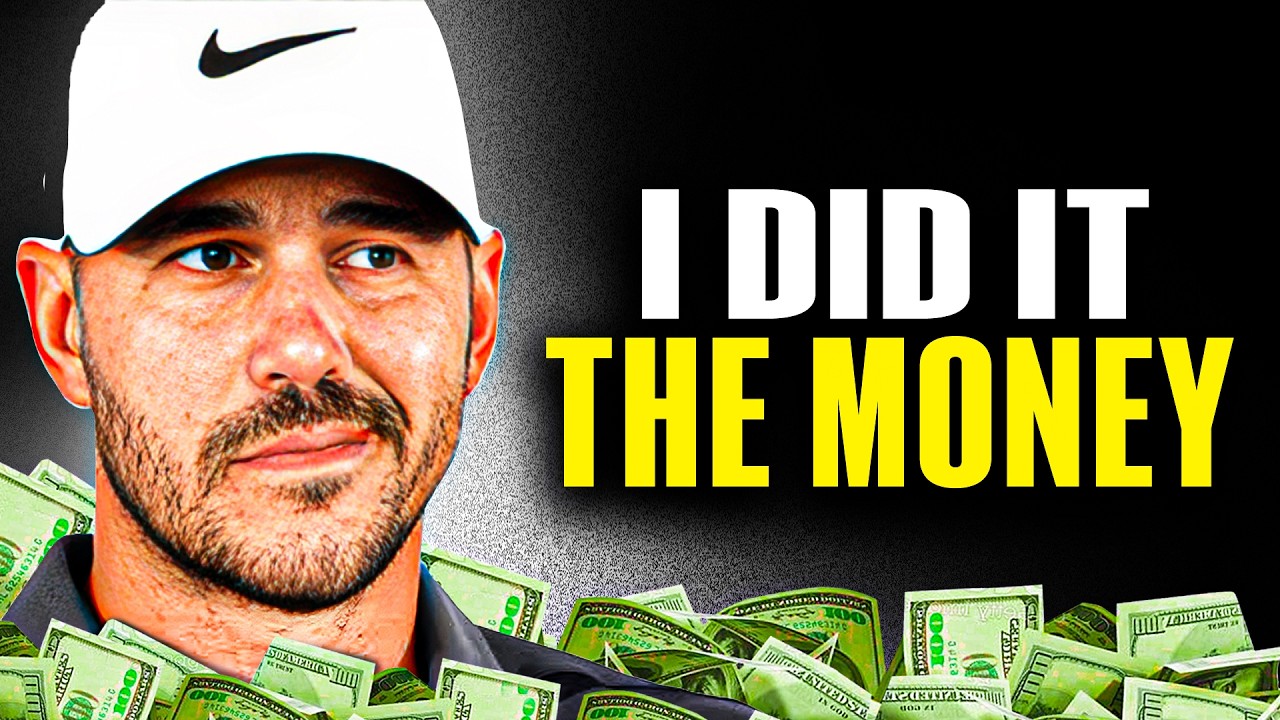
Brooks Koepka Made $100M Then SHOCKED The Golf World
Brooks Kepka pocketed $100 million to join Live Golf. While critics claimed his competitive career was finished, then he silenced everyone by winning the PGA Championship as a Live player. Was this bold move the ultimate gamecher? Did Coepka outsmart the golf establishment with his controversial career decision? In this video, we explore how his 54 transition unfolded against widespread skepticism, examine what everyone missed in their rush to judgment, and reveal why the doom and gloom predictions fell flat against reality. We’ll analyze the financial calculus, competitive implications, and what his success means for other pros considering similar moves in golf’s evolving landscape. When Brooks Kepka hoisted the WMaker Trophy at Oak Hill in May 2023, you could hear the collective gas from the golf world. There stood a 54th golf player, supposedly semi-retired, according to his critics, holding one of golf’s most prestigious trophies. The narrative was supposed to be simple. Join live, take the money, kiss your competitive edge goodbye. But Kepka clearly didn’t get that memo. The criticism had been relentless since he jumped ship to the Saudibacked tour. Former peers suggested he’d chosen an early retirement package over real competition. Golf analysts questioned whether Lee’s 54 hole no cut format could prepare players for major championships. His world ranking had plummeted from the top 10 to outside the top 100 due to Liv’s lack of official ranking points. Yet there he was at the PGA Championship, eyes locked with determination, staring down the sport’s best with that trademark steely gaze. The crowd fell silent each time he approached a crucial putt, then erupted as he methodically built his lead throughout the tournament. At Oak Hill, Kekka battled through brutal conditions over four days, navigating a course that punished the slightest mistakes. Victor Havland, a rising PGA Tour star, made a Sunday charge worthy of the major stage. Scotty Sheffller, arguably the best player in the world at that moment, lurked on the leaderboard throughout the final round. The pressure was enormous. A win would validate his controversial move. A collapse would feed the narrative that he’d lost his competitive edge. But pressure has always seemed to fuel Coppa. His mantra has long been that majors are the easiest tournaments to win because most players can’t handle the spotlight. At Oak Hill, he proved once again that he’s built differently. His victory wasn’t some miraculous outlier. Kept seized control with a masterful third round, taking a one-shot lead into Sunday. When the moment called for it, he delivered clutch par saves and strategic plays that had defined his previous major victories. This was Kepka doing what Kepka does best. With this victory, he claimed his fifth major championship, joining an elite club that includes icons like Sevi Balisteros and Byron Nelson. A player competing less frequently against smaller fields, had matched the major tallies of two golf legends. His intense focus was evident as his final putt dropped, allowing himself only a brief smile before composing himself for the trophy ceremony. Coppka became the first LIIV golf player to capture one of golf’s four biggest prizes. He shattered the narrative that 54 players couldn’t maintain the competitive edge needed for majors. While critics pointed to Liv’s format as disadvantages, Kepka turned those elements into strengths. The reduced schedule may have actually benefited his troublesome knee, allowing him to arrive at majors healthier and more rested than PGA Tour players grinding through a demanding calendar. The team aspect of Liv might have rekindled his love for the game after years of solitary pursuit. The financial security removed the pressure of playing for a paycheck, freeing him to focus solely on adding to his major championship legacy. His triumph forced the golf world to confront an important question. What if for players of Kepka’s caliber and mindset, the ELV golf model actually enhances their ability to perform in the tournaments they care about most, what if less competitive golf but more targeted preparation is the optimal formula for major championship success? Behind Kepka’s direct admission that he did it for the money lies a story about mortality that few professional athletes openly discuss. What happens when your body starts breaking down before your competitive fire burns out? For Coppka, joining Live Golf represented both financial security and physical survival in a sport that had already begun taking a severe physical toll. “I did it for the money. I’m not the first person to do it for money, and I won’t be the last,” Kepka told reporters with a refreshing honesty rarely seen in professional sports. This candid statement, devoid of the typical platitudes about growing the game, acknowledged what most suspected while hinting at deeper motivations that shaped his decision. The reality few fans understood was that Kepka’s career had reached a critical crossroads long before LIV golf appeared. His troublesome knee had become the ticking time bomb, threatening his competitive prime. After multiple surgeries, each tournament became a physical gamble. During the 2021 PGA Championship, cameras captured Kepka grimacing in pain as he navigated Kiawa Island’s uneven terrain, a vivid illustration of the daily battle he fought against his own body. For a player with chronic health issues, the traditional PGA Tour schedule presents a brutal challenge. 4-day tournaments with cuts mean players often push through pain to avoid wasting their effort, potentially worsening injuries. The financial pressure to play creates a vicious cycle where injured players rush back before fully healing. 54 Golf’s format offered co-epa longevity. The 54 hole tournaments without cuts meant predictable physical demands. Shotgun starts created more consistent recovery times. Team play provided motivation without the relentless individual pressure of the PGA Tour. These structural differences represented a career extension plan for a champion wondering how much longer his knee would allow him to compete. The financial component of Cupka’s decision operated like a comprehensive insurance policy. Athletes in individual sports face a particularly cruel reality. Unlike team sports with guaranteed contracts, their income depends entirely on their ability to compete. A career-ending injury means immediately losing your primary income source. When Coppa’s contract reportedly exceeded $100 million, he essentially purchased protection against his body’s increasing vulnerability, converting uncertain future earnings into guaranteed security. The timing proved perfect from Coppka’s perspective. He had already accomplished nearly everything a professional golfer dreams of achieving. With major championships and a world number one ranking secured, his legacy was established. The question wasn’t whether he could reach the mountaintop. He’d planted his flag there multiple times, but how long his body would allow him to remain relevant. This context transforms how we should view Kepka’s decision. It wasn’t a player selling out his competitive years. Rather, it was the strategic move of a champion who’d proven himself, faced physical limitations, and secured his financial future while creating conditions to extend his competitive relevance. The decision came with significant costs. The backlash was immediate. Former peers questioned his competitive desire. Fans who had cheered his major victories suddenly viewed him as a mercenary. For a player who had built his reputation on an uncompromising pursuit of excellence, these criticisms struck at something money couldn’t buy. Respect. Even more painful was the potential competitive sacrifice. Would the reduced schedule keep him sharp for majors? Would practicing against smaller fields dull his competitive edge? Would diminished spotlight affect his motivation? These questions represented the genuine competitive gamble behind the financial security, the true cost of ensuring against an uncertain future. The golf world waited for Kepka’s game to deteriorate after joining Liv, anticipating the competitive equivalent of muscle atrophy. But as Augusta Nationals, Aelia’s bloomed in April 2023, something unexpected happened. The player everyone had written off found himself tied for second at the Masters, golf’s most prestigious tournament. He genuinely contended pushing eventual champion John Rom until Sunday’s back nine. This performance carries profound meaning because of its surrounding context. Kepka arrived at Augusta having played significantly fewer competitive rounds than his PGA Tour counterparts. The conventional wisdom suggested this reduced schedule would leave him unprepared for major championship pressure. Instead, he appeared fresher, more focused, and ready when many others faltered. The Master’s showing wasn’t an outlier. Since joining Lv, Kepka’s major championship performances have maintained a remarkably consistent pattern. When stakes rise and the world’s best gather, he elevates his game to his trademark levels. This directly contradicts the narrative that 54 players would struggle against the full PGA Tour contingent. His excellence extends beyond majors. Within the 54th ecosystem, Kepka has become a dominant force. His victory at the 2022 LIV Golf Invitational Jedha showcased his ability to close tournaments. Even more impressively, he captured the 2023 LIIV Individual Championship, confirming his status as the premier player on the Upstart Tour. These accomplishments challenge the dismissive characterization of 54 competitions as glorified exhibitions. Kepka’s experience offers a fascinating counterpoint to golf’s traditional competitive model. For decades, the sport operated like a relentless machine. Weekly 72-hole tournaments to keep players sharp. The cutline supposedly provides necessary pressure to simulate major championship conditions. Four round events allegedly separate the elite from the merely good. But what if these beliefs aren’t universal? With fewer mandatory tournaments and schedule certainty, Coppa now structures his practice and physical training with laser precision. Rather than grinding through events where motivation waivers, he channels his notorious intensity toward tournaments that matter to his legacy. he can fine-tune his preparations specifically for Augusta’s elevation changes or St. Andrews wind conditions rather than adapting weekly to different venues. Some sports scientists suggest this approach represents optimization rather than compromise by reducing tournament wear and tear while maintaining focused competitive repetitions. Players like Coppa might extend their prime competitive years while improving performance in target events. It’s golf’s quality over quantity equation with results that speak volumes. This raises uncomfortable questions for traditionalists. If an accomplished player maintains or enhances his major performances while playing fewer 54 whole events, what does that say about the necessity of the PGA Tour’s traditional format? Are we clinging to competitive structures based more on tradition than effectiveness? For Kepka specifically, the LIV format aligns perfectly with his approach to competition. Here’s a player who repeatedly stated he prepares differently for majors, even admitting to coasting through regular PGA Tour events. Now, he’s in a system that essentially institutionalizes that philosophy. Fewer events, guaranteed paydays, and freedom to peak precisely when desired. Motivation remains another overlooked factor. Nothing drives elite athletes like proving critics wrong. When Coepka joined Liv, the golf establishment created a narrative that he chose comfort over competition. For a player fueled by perceived slights, this provided powerful motivation. Every major now offers not just another trophy opportunity, but validation of his career choices on golf’s biggest stages. The experiment continues. One strong season doesn’t definitively answer whether the LIV format sustains elite competitive skills long term, but it certainly complicates the simplistic narrative that leaving the PGA Tour automatically diminishes a player’s competitive abilities. Success between the ropes doesn’t always tell the complete story. For all of Kepka’s major championship heroics since joining LIV, his world ranking has paradoxically plummeted from number one to outside the top 180. A mathematical contradiction that perfectly symbolizes his current reality. The numbers on his paycheck grew exponentially while his global golf standing virtually disappeared overnight. Behind Coppka’s public defense of his controversial move lies a growing undercurrent of frustration. In April 2025, he dropped a bombshell admission that cracked the carefully constructed facade. I think we all hoped it would have been a little bit further along, and that’s no secret. The statement revealed genuine disappointment slipping through the practiced media responses of a player who’d received a 9-figure payment to be the face of golf’s new frontier. What exactly wasn’t meeting the expectations of a man who just received $100 million? The broadcasting situation represents a significant downgrade. After years dominating network television coverage on the PGA tour with Kepka’s Sunday charges beamed into millions of American living rooms, he now competes primarily on YouTube streams and Fox broadcasts with dramatically lower viewership. His competitive brilliance now unfolds before a fraction of the audience that once witnessed his major triumphs. Like a virtuoso pianist performing in an empty concert hall, the sponsor exodus compounds his frustration. Kepka abandoned the PGA Tours ecosystem of corporate partnerships, fan relationships, and media attention. The limited reach of Levy’s broadcast has directly impacted his marketability, creating a commercial downside to balance against the guaranteed LAV money. His official World Golf ranking situation, plummeting to 181st despite contending in majors, stands as perhaps the most visible symbol of his professional compromise. This ranking collapse isn’t merely about ego. It threatens future major championship qualification, the tournaments that define legacy in golf. The gleaming trophy of financial security now bears the rust of competitive isolation and diminished legitimacy on the global stage. This tangible professional erosion bleeds into something more personal. The social cost that haunts his decision. Former peers have distanced themselves. Media outlets apply sellout labels with increasing frequency. and fan perception has shifted to viewing his decision through a purely financial lens. These subtle changes represent a continuous tax on his professional identity that even nine figures can’t fully offset. When Kepka speaks about Elive’s development not being further along, his frustration becomes palpable. The league pitched itself as golf’s innovative future, a streamlined format, team competition, and guaranteed earnings transforming how fans consumed the sport. Yet three years in, many events lack the energy and prestige of the best PGA tour stops that Kepka has specifically mentioned missing. The widening gap between the promised revolution and emerging reality creates an uncomfortable question. Does the $100 million compensation package justify the competitive, commercial, and social costs? For a player defined by brutal honesty, the cracks in his public confidence hint at deeper frustrations with the very league he sacrificed everything for. This tension sets up the logical next question about Coppka’s future. His contract reportedly runs through 2026, leaving him facing a pivotal career decision soon. Will he recommit to the 54th experiment despite his misgivings? Or might he contemplate returning to the PGA Tour, where world ranking points, network television coverage, and unquestioned legitimacy await? The answer may reveal whether the golden handcuffs of LIV’s riches have become too heavy to bear. The whispers became impossible to ignore when Fred Couples dropped a bombshell on Seattle radio in early 2025. “I talked to Brooks all the time and he wants to come back,” the former Masters champion declared without hesitation. “Couples didn’t stop there,” adding fuel to what had been smoldering speculation. “I will believe he really wants to come back and play the tour.” Coming from a respected veteran with direct access to Kipka, these statements represented the first concrete suggestion that Gulf’s $100 million man might be having second thoughts about his Saudibed adventure. When confronted with couple’s comments, Kepka’s response was telling, not for what he said, but for what he didn’t say. Rather than issuing a firm denial, he retreated to his standard response. I’ve got a contract obligation out here to fulfill, and then we’ll see what happens. This carefully crafted non-answer preserves his options while revealing virtually nothing about his true intentions. The statement of someone keeping all doors open in an uncertain landscape. What makes this situation particularly intriguing is that Kepka’s apparent ambivalence comes during what should be the prime of his career. At 35, with his injury concerns largely managed through LIIV’s reduced schedule, he remains one of golf’s elite talents. Yet, there’s a growing sense that he misses certain aspects of life on the traditional tour. The practice round at Augusta National in 2025 raised eyebrows throughout the golf world. There was Kepka walking the pristine fairways alongside Justin Thomas, Adam Scott, and Fred Couples, the very man who would later claim Kepka wants a PGA Tour return. During that session, observers noted Queka and Thomas engaged in animated conversation about course strategy, laughing like old friends despite representing opposing sides of golf’s divide. This glimpse into the relationships Quea has maintained despite the sport’s bitter civil war may prove crucial as he contemplates his next move. The backdrop to this speculation is the ongoing negotiations between the PGA Tour and Saudi Arabia’s public investment fund. What began with a shocking framework agreement announced in June 2023 has devolved into nearly two years of stop start talks with no resolution. Rory Mroy maintains that a deal should and will be done, but insiders felt less optimistic in early 2025 with financial penalties for LIIV defectors emerging as a major sticking point. This prolonged uncertainty creates a challenging situation for Kepka. If his contract indeed expires after the 2026 season as reported, he’ll face a career crossroads without knowing what the professional golf landscape will look like. Will there be a unified tour? Will LIV and the PGA Tour continue as separate entities, or will some hybrid model emerge? The answers will undoubtedly influence Coka’s decision-making process. If a merger occurs before his contract expires, the entire conversation becomes moot. But if the divide persists, Kepka will have to choose whether to recommmit to Lv Golf or attempt a return to the PGA Tour. While Kepka secured generational wealth with his Live decision, money isn’t everything. Even to someone who candidly admitted financial motivation for his initial jump, the competitive structure, global recognition, and camaraderie of the traditional tours possess their own powerful pull. When Kepkco watches major championships where he once dominated receiving full television treatment, while his LIIV victories get minimal attention, it likely creates professional dissonance. Perhaps most revealing is what Kupka hasn’t said. Not once has he categorically denied interest in returning to the PGA Tour. Not once has he committed to LIIV Golf beyond his current contract. In a sports landscape where players routinely pledge eternal loyalty, Kubka’s calculated ambiguity speaks volumes about his mindset. As Koka’s story continues to unfold, we’re left with a career that defies easy categorization. His experience embodies the complex reality professional golfers face when balancing financial security against competitive aspirations, particularly when dealing with health concerns. Despite capturing another major championship after signing his $100 million contract, Kepka’s diminished visibility raises questions about long-term impact. With his deal expiring in 2026, what will he prioritize next? Financial security or competitive legacy. The speculation remains wide open. Kepka’s career represents a nuanced decision made by an athlete navigating unprecedented changes in professional golf, challenging us to reconsider what success truly means. What are your thoughts on Brooks Kepka? Let us know in the comments.
Brooks Koepka Made $100M Then SHOCKED The Golf World
✅ Please Subscribe To The Channel and Join Us In Our Journey To 20k subs https://www.youtube.com/channel/UCjo1Tb8RFFlMXAqZ3VAYIBg
#golf #golfer #golfswing
Copyright Disclaimers –
Our content is used in adherence to YouTube’s Fair Use guidelines. This may include copyrighted video clips and images used under U.S. Copyright Act Section 107 for commentary, news reporting, educational purposes, and more, without specific authorization from copyright holders.
Attention! Videos on the channel are exclusively documentary, informational, and narrative in nature. All information about the case is taken from various sources on the Internet! The author is not engaged in his own investigation and does not try to hurt anyone’s feelings!
Golf's Biggest SCANDALS They Tried To HIDE
https://youtu.be/yajj3SX5bbI
Those who moved to liv golf are forgotten people now
LVI better than PGA
Ai cant even pronounce LIV golf embarassing
LVI better than PGA
These AI voice overs are awful
Very good video
Good player