



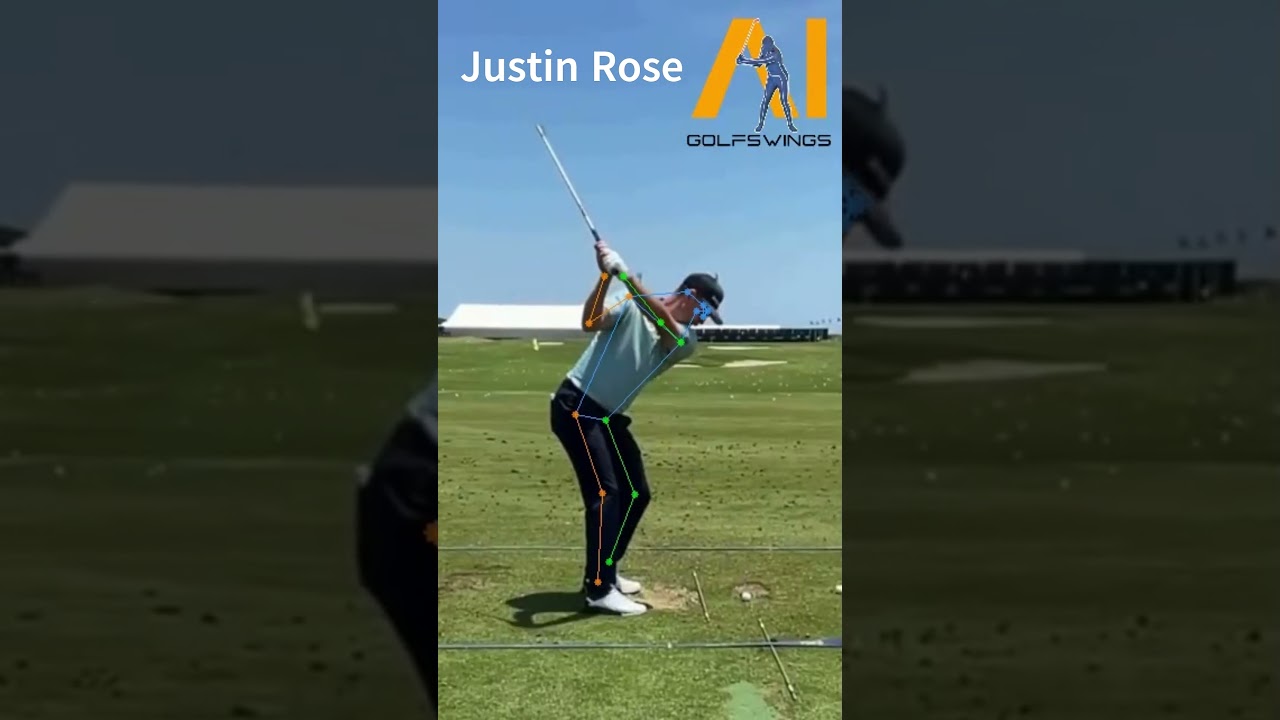
Justin Rose AI Slow Swing Sequence
Transition
Lower body leads. Pressure shifts into the lead side as the shaft shallows naturally. Sequence (hips → torso → arms → club) is textbook, creating space and preserving lag without forcing it.
Downswing & Impact
Hands work from the inside with torso opening through impact. Handle leads with irons for ball-then-turf contact and compressed flight. Face is marginally open to a slightly leftward path to hold the fade; dynamic loft control is excellent.
Release & Finish
Full rotation, posted lead side, and balanced, high-hand finish. No stalls—energy flows all the way to the end.
Why GolfSwings.ai scored it 84%
Sequencing Efficiency: Elite hip-to-torso timing yields stable club delivery.
Clubface Control: Minimal face-to-path volatility; fade bias is intentional and repeatable.
Impact Alignments: Forward shaft lean (irons) with stable lead wrist; tight strike window.
Balance & Variability: Movements stay in optimal bands across frames; low dispersion profile.
What to copy (for most golfers)
Width early, patience late: Keep the first half of the backswing wide and unhurried, then let the lower body start the downswing.
Pressure shift, not slide: Move pressure into the lead foot in transition while keeping the pelvis centered—creates space without early extension.
Hold the face, rotate the body: For a controlled fade, rotate through while keeping the face passive (no last-second flip).+